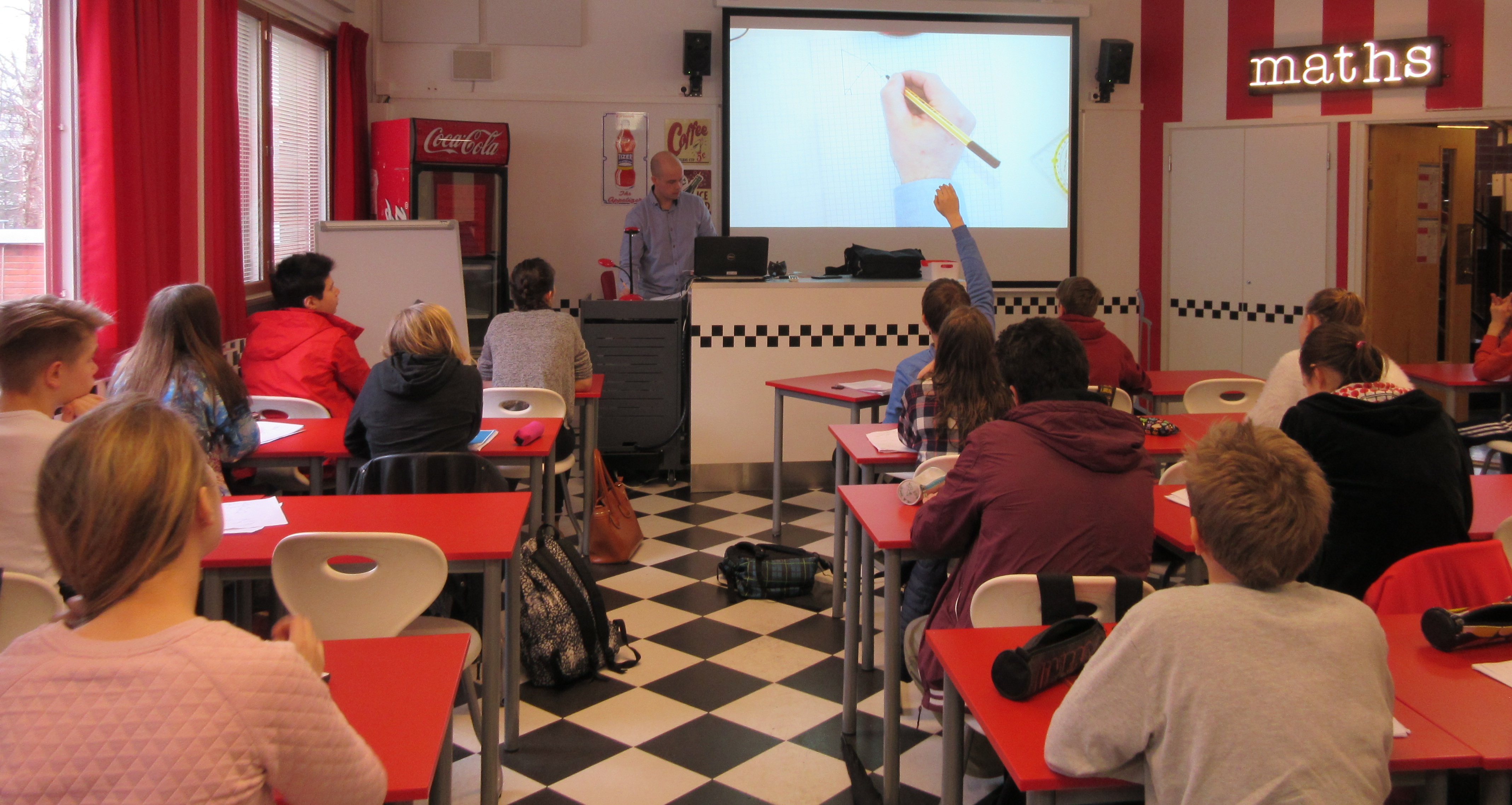
When I left my 7th grade math classroom for my Fulbright research assignment in Finland I thought I would come back from this experience with more inspiring, engaging, innovative lessons. I expected to have great new ideas on how to teach my mathematics curriculum and I would revamp my lessons so that I could include more curriculum, more math and get students to think more, talk more and do more math.
This drive to do more and More and MORE is a state of existence for most teachers in the US….it is engrained in us from day one. There is a constant pressure to push our students to the next level to have them do bigger and better things. The lessons have to be more exciting, more engaging and cover more content. This phenomena is driven by data, or parents, or administrators or simply by our work-centric society where we gauge our success as a human being by how busy we are and how burnt out we feel at the end of the day. We measure our worth with completed lists and we criminalize down time. We teach this “work till you drop” mentality to our students who either simply give up somewhere along the way or become as burnt out as we find ourselves.
When I arrived in Finland I did not find big flashy innovative thought provoking math lessons. I did not find students who were better at mathematics or knew more math content. In fact the Jr. High and High school math classrooms have been rather typical of what I have experienced in Indiana. And most of the struggles (like students not remembering their basic math facts) were the same. The instruction and classroom structure of a math classroom in Finland follows the basic formula that has been performed by math teachers for centuries: The teachers go over homework, they present a lesson (some of the kids listen and some don’t), and then they assign homework. While some lectures have been wonderful and I have gotten to observe some fantastic teachers, I would say that on the whole I have seen more engaging and interactive secondary math instruction from teachers in the United States. It is rare to see a math lesson that is measurably better than those found in my district and I have seen several that were actually far worse.
So, what is the difference? If the instruction in secondary mathematics is the same or sometimes worse than those found in the US, why are Finnish students succeeding and ours are failing? The difference is not the instruction. Good teaching is good teaching and it can be found in both Finland and in the US. (The same can be said for bad teaching.) The difference is less tangible and more fundamental. Finland truly believes “Less is More.” This national mantra is deeply engrained into the Finnish mindset and is the guiding principal to Finland’s educational philosophy.
Less IS more.
They believe it. They live by it. Their houses are not larger than what they need in which to comfortably live. They do not buy or over consume. They live simply and humbly. They don’t feel the need to have 300 types of cereal to choose from when 10 will do. The women wear less make-up. The men don’t have giant trucks (or any vehicles at all, really). Instead of buying hundreds of cheap articles of clothing the Finns buy a few expensive items of high quality that will last for decades rather than months. They truly believe and live by the mentality of less is more.
Conversely in the US we truly believe “more is more” and we constantly desire and pursue more in all areas of our lives. We are obsessed with all things new, shiny and exciting and are constantly wanting to upgrade our lives. Out with the old in with the new! This mentality of “more is more” creeps into all areas of our lives and it confuses and stifles our education system.
We can’t even stick to ONE philosophy of education long enough to see if it actually works. We are constantly trying new methods, ideas and initiatives. We keep adding more and more to our plates without removing any of the past ideas. Currently we believe “more” is the answer to all of our education problems— everything can be solved with MORE classes, longer days, MORE homework, MORE assignments, MORE pressure, MORE content, MORE meetings, MORE after school tutoring, and of course MORE testing! All this is doing is creating MORE burnt out teachers, MORE stressed out students and MORE frustration.
Finland on the other hand believes less is more. This is exemplified in several ways for both teachers and students.
Less = More
1. Less Formal Schooling = More Options
Students in Finland start formal schooling at the age of seven. Yes, seven! Finland allows their children to be children, to learn through playing and exploring rather than sitting still locked up in a classroom. But don’t they get behind? No! The kids start school when they are actually developmentally ready to learn and focus. This first year is followed by only nine years of compulsory school. Everything after ninth grade is optional and at the age of 16 the students can choose from the following three tracks:
• Upper Secondary School: This three year program prepares students for the Matriculation Test that determines their acceptance into University. Students usually pick which upper secondary school they would like to attend based on the school’s specialties and apply to get into that institution. I think of this as a mixture of High School and College. (In recent years a little less than 40% choose this option.)
•Vocational Education: This is a three year program that trains students for various careers as well as gives them the option to take the Matriculation test to then apply for University should they so choose. However, the students in this track are usually content with their skill and either enter the workforce or they go on to a Poly-technical College to get further training. (A little less than 60% choose this track.)
(But wait! Shouldn’t everyone take calculus, economics, and advanced chemistry?! Shouldn’t everyone get a University degree?! No, not everyone has to go to University! Hmmm….. interesting….. What if we provided options for those who want to become successful (and very profitable) welders or electricians? What if we didn’t force students who know that their talents reside outside of the world of formal academics to take three years of high school classes that they found boring and useless? What if we allowed them to train in and explore vocations they found fascinating and in which they were gifted? What if we made these students feel valued and like they had a place in the education realm?)
• Enter the workforce. (Less than 5% choose this path)
2. Less Time in School = More Rest
Students typically start school between 9:00 and 9:45. Actually, Helsinki is thinking of creating a law stating that schools cannot begin before 9:00 am because research has consistently proved that adolescents need quality sleep in the morning. The school day usually ends by 2:00 or 2:45. Some days they start earlier and some days they start later. Finnish students’ schedules are always different and changing; however they typically have three to four 75 minute classes a day with several breaks in between. This overall system allows both students and teachers to be well rested and ready to teach/learn.
3. Fewer Instruction Hours = More Planning Time
Teachers have shorter days as well. According to the OECD (Organization for Economic Cooperation and Development) an average Finnish teacher teaches 600 hours annually or about 4 or less lessons daily. An average U.S. teacher almost doubles that teaching time with an average of over 1,080 hours of in-class instruction annually. This equals an average of six or more lessons daily. Also, teachers and students in Finland are not expected to be at school when they do not have a class. For example, if they don’t have any afternoon classes on Thursdays, they (both teachers and students) can simply leave. Or if their first class on a Wednesday starts at 11:00, they don’t have to be at school until that time. This system allows the Finnish teacher more time to plan and think about each lesson. It allows them to create great, thought provoking lessons.
4. Fewer Teachers = More Consistency and Care
Elementary students in Finland often have the SAME teacher for up to SIX YEARS of their education. That is right! The same teacher cares for, nurtures and tends to the education of the same group of students for six years in a row. And you had better believe that during those six years with the same 15-20 students, those teachers have figured out the individual instructional needs and learning styles of each and every student. These teachers know where each of their students have been and where they are going. They track the kids’ progress and have a personal invested interest in seeing the kids succeed and reach their goals. There is no “passing the buck” onto the next teacher because they ARE the next teacher. If there is a discipline or behavior problem, the teacher had better nip it in the bud right away or else deal with it the next six years. ( Some schools in Finland only loop their elementary children for three years at a time instead of six, however the benefits are still the same. )
This system is not only helpful to a child because it gives them the consistency, care and individualized attention they need, it also helps the teachers understand the curriculum in a holistic and linear way. The teacher knows what they need to teach to get them to the next step, while also giving the teachers freedom to work at the pace of their students. Teachers don’t feel the pressure to speed up or slow down so that they are “ready” for the teacher next year. Again, they are the teacher next year and they control the curriculum! They know where the kids are and what they have learned and will plan according to the students’ needs! I really believe this is a HUGE part of Finland’s success story and it does not receive enough attention.
5. Fewer Accepted Applicants= More Confidence in Teachers
So……children have the same teacher for three to six years. What if your kid gets a “bad teacher”? Finland works very hard to make sure there are no “bad teachers.” Primary education is THE most competitive degree to get in Finland. The elementary education departments in Finland only accept 10% of all applicants and turns down thousands of students annually. A person not only has to be the best and the brightest to become a primary teacher, they also have to have passed a series of interviews and personality screenings to get in. So, it isn’t enough to be the smartest in your class, you also have to have the natural ability and drive to teach.
Finland understands that the ability to teach isn’t something that can be gained from studying. It is usually a gift and passion. Some have it, some don’t. The few universities with teaching programs in Finland make sure they only accept applicants that have that gift. On top of excellent grades, and a natural disposition to be a teacher, all teachers must get a Master’s degree and write a Master’s Thesis. This generates a lot of confidence and trust in Finland’s teachers. Parents trust the teachers to be highly qualified, trained, and gifted individuals. They do not try to interfere or usurp their authority and decisions. I asked a math teacher how many emails they typically get from parents. They shrugged and answered “About five or six”. I said, “Oh, I get about that much a day too.” They then answered…”No! I meant five or six a semester!” Again, what would it be like to live in a society based on trust and respect?
6. Fewer Classes= More Breaks
As I stated before, students only have three to four (or rarely, five) classes a day. They also have several breaks/recesses/ snack times during the day and these usually happen outside come rain or shine. These 15 to 20 minute gives them time to digest what they are learning, use their muscles, stretch their legs, get some fresh air and let out the “wiggles.” There are several neurological advantages for these breaks. Study after study supports the need for children to be physically active in order to learn. Stagnation of the body leads to stagnation of the brain and unfocused, “hyper” children.
The teachers also have these breaks. The first day I was in a school in Finland a teacher apologized for the state of the “Teacher Room.” She then commented on the fact that all teacher rooms must look like this. I laughed and politely agreed, but in my head I was thinking; “What is a teacher room?” A teacher’s room is what used to be called the teacher’s lounge in the U.S…back before they went extinct. In Finland these rooms are always full of teachers who are either working, preparing, grabbing a cup of coffee, or simply resting, socializing, and mentally preparing for their next class.
Secondary level teachers usually have 10 to 20 minute breaks in between classes and often have a few skip (prep) periods as well. These rooms are different depending on the school, but from what I can tell the basic formula is a few tables, a few couches, a coffee pot, a kitchen, a selection of free fruit and snacks, and teachers to talk and collaborate with. A few of them even have massage chairs! Ha!
So, why don’t these rooms of collaboration, support and solace exist in the U.S.? We do not have TIME! Every day we teach six to seven classes in a row with no breaks. The three to five minute passing periods we do get are often used to answer emails from parents, erase the board, get ready for the next class, make copies, answer student questions, pick up the mess left behind by the students, and (heaven forbid) go to the bathroom! If we have a spare moment we are then expected to monitor the hallway because we can’t trust students to get to class without supervision. The luxury of actually sitting down for 10 minutes and enjoying a cup of coffee with some colleagues is an absolute dream, and having a day with only three classes—that is a fantasy!
7. Less Testing = More Learning
Imagine all of the exciting things you could do with your students if there wasn’t a giant state test looming over your head every year. Imagine the freedom you could have if your pay wasn’t connected to your student’s test scores. Imagine how much more fun and engaging your lessons would be!
Although it still exists, there is overall less pressure on the teacher in Finland to get through the curriculum. The teacher is simply trusted to do a good job and therefore they have more control over their classroom and its content. The teacher is able to take more risks and try new things and create exciting, engaging curriculum that allows students to become skilled individuals ready for the real world. They have time to teach skills that allow students to develop into individuals who know how to start a project and work systematically to accomplish a goal. They have time to teach craft education where students get to learn how to do real life skills like sewing, cooking, cleaning, woodworking and more! And while they are learning these amazing skills they are also learning math and problem solving and how to follow directions!
8. Fewer Topics = More Depth
I have observed several fifth through ninth grade math classes in Finland. I have looked at the curriculum covered over these five years of education and I realized that I attempt to teach the content of five years of Finnish math education in one year. Each math topic presented in every grade level I have observed here is include in my seventh grade curriculum.
Again, the American mentality of “more is more” simply does not work. If I am to get through everything I am expected to do in one year I have to introduce a new topic/lesson every other day and I always feel “behind”. Behind what, I am not sure, but the pressure is there pushing me and my students along. In Finland, teachers take their time. They look deeper into the topic and don’t panic if they are a little behind or don’t cover every topic in the existence of mathematics in a single year.
Also, students only have math a few times a week. In fact, after Easter Break, all of my seventh graders only have math ONCE a week! My heart still panics a little when I hear this! I can’t believe that is enough math time! How will they be ready for the tests?! Oh— wait. There are no tests. There is no need to rush through. The students get to actually understand the material before they are forced on to a new topic. One teacher showed me a course book and said that it had too many topics for one five week grading period. I looked at the entire book and had to stifle a chuckle because it essentially covered what would be found in ONE chapter from my textbook. Why do we push our kids in the U.S. to learn so much so quickly? No wonder they are stressed out! No wonder they give up!
9. Less Homework = More Participation
According to the OECD, Finnish students have the least amount of homework in the world. They average under half an hour of homework a night. Finnish students typically do not have outside tutors or lessons either. This is especially shocking when you realize Finnish students are outscoring the high performing Asian nations whose students receive hours of additional/outside instruction. From what I can observe, students in Finland get the work done in class, and teachers feel that what the students are able to do in school is enough. Again, there is not pressure to have them do more than what is necessary for them to learn a skill. Often the assignments are open-ended and not really graded. Yet, the students work on it in class diligently. It is very interesting to see what happens to the students when they are given something to do. The students who were not listening to the lesson at all put away their phones and start working on the task set before them. Even if it is just a suggested assignment, they give it their full attention up to the end of class. It is almost like there is an unspoken agreement: “I won’t give you homework if you work on this while you are in my classroom.” This system has really made me think about the amount of homework I assign on a daily basis.
10. Fewer Students = More Individual Attention
This is obvious. If you have fewer students you will be able to give them the care and attention they need to learn. A Finnish teacher will have about 3 to 4 classes of 20 students a day- so they will see between 60 to 80 students a day. I see 180 students every single day. I have 30 to 35 students in a class, six classes in a row, 5 days a week.
11. Less Structure = More Trust
Trust is key to this whole system not structure. Instead of being suspicious of one another and creating tons of structure, rules, hoops and tests to see if the system is working, they simply trust the system. Society trusts the schools to hire good Teachers. The schools trust the teachers to be highly trained individuals and therefore give them freedom to create the type of classroom environment that is best for their individual students. The Parent’s trust the teachers to make decisions that will help their children learn and thrive. The Teachers trust the students to do the work and learn for the sake of learning. The Students trust the teachers to give them the tools they need to be successful. Society trusts the system and gives education the respect it deserves. It works and it isn’t complicated. Finland has it figured out.
Less IS More.

 Filling My Map
Reblogged this on Komal Shah's Blog and commented:
Indian Schools should start with smaller changes if not big ones – Training quality teachers should be #1 on the list.
LikeLiked by 2 people
Pingback: Ahli Geologi Masuk Kelas | Made Nuryadi
Pingback: Thoughty Thursday: Things that made me go hmmmm on the interwebz, April 26-May 2, 2015 | Writerly Goodness
A great post and an awesome blog, thanks! I am a Finnish vocational school English teacher. I have four kids between the ages of 12 and 15, so I have personal experience of the current comprehensive school system, too. I found your post insightful and the things you described sounded very familiar to me. For example, some people have said the teacher may change during the first school years. Of course, there may be maternity leave or something like that, but the basic approach is that teachers don’t change much during your first six years of schooling. I do think it creates good continuity and trust and reduces stress levels.
Some comments:
1) There are many things I have taken for granted as a teacher. I am respected, teachers are considered professionals who do a crucial job and deserve all the responsibility they get. I have a lot of freedom as to how I will implement the curriculum. I work at school 20-28 hours a week, depending on the study period. This allows me to plan projects, correct exams, prepare for lessons etc comfortably from home, too. As my job gets very intensive I feel this flexibility gives me lots of energy and helps keep me motivated. My pay is is no way related with my students’ test results.
2) This certain (relative) freedom. space, lack of panic, longer breaks, shorter school days, less homework… gives both students and teachers space to grow. Even if you study the most wonderful things in an awesome environment, if you are bombarded with too much information, too many demands, too much grading/evaluation… it drains the life out of you. It takes the joy out of things, especially in the long run, even if you are a fast learner/ a super-motivated teacher.
3) There are lots of curricula changes in all levels of education in Finland now. In comprehensive schools, Ilmiö-oppiminen (Phenomenon-teaching) is a pretty new, interesting concept. Here, you study a phenomenon (such as water or emptiness) from the points of view of several school subjects, in a multi-scientific way. At vocational schools, integrated teaching is something that should be implemented more than before. This means integrating general subjects such as English or Maths into the field of study. Thus, we study part of our English lessons role-playing at the welding workshop or nursing class. It is very challenging but a lot of fun. Pads and mobile phones are used more and more in teaching. I think we do need all these ideas, it is not enough just to give teachers and students enough space and freedom to learn. But with the space comes the spark to try out new stuff, too!
4) One challenge we have is that we spend a lot of money and time on students who have difficulties at school. This is good and healthy, but I see a number of students who haven’t learnt to be responsible for themselves even by the age of 18, because everybody (teachers, school curators, parents) have helped them get through without making them stick to any kind of a plan (even coming to school). These students are of course a small minority and many, many more have found the support they get to be a real lifesaver. But still. Second, we don’t support super talented students enough.
🙂
LikeLiked by 2 people
Your #4 is a huge part of the problem in the USA. Not only with students in school, but society in general. Our welfare system creates a pattern handed down from parent to child, that is exactly what you describe.
People learn to rely upon what government gives them, instead of being responsible for themselves.
LikeLiked by 1 person
Check out the Finish welfare programs, your argument is bogus. Less child poverty = more success in school.
LikeLike
There is a much stronger social support network in Finland than there is in the US, your welfare state comment is a myth. We don’t have a welfare state, we have poverty so grinding that the school to prison pipeline is all some of our kids will experience.
LikeLiked by 1 person
Richard Teran, that is such bunk! Our welfare systems is nearly non-existent. Finland has far more govt programs given it is a Socialist Democracy and education, healthcare and childcare is provided by the govt. Our kids here get a maximum in some states (AZ) of one year at $204 per month! That wouldn’t support folks more than a week much less a month, so not sure what the heck you are talking about. Your comrads are wanting to further privatize things which results in eventual extreme costs and less accountability and lower quality. This notion that govt is bad is a myth! We have the smallest govt with the fewest number of govt employees than we have had in a century, yet, we have spent more and with poor outcomes. Not buying any of your argument.
LikeLiked by 2 people
I have often read that Russian kids also start school at age 7, and I believe that is still the case nationwide.
LikeLiked by 1 person
I once got a copy of a Russian math teacher’s training manual (English translation, I never got around to learning Russian), and it was awesome.
LikeLiked by 1 person
Pingback: Finlandiya Eğitim Sisteminin Özü: “Az Olan Daha İyidir!
Pingback: Weekend reading: May 9, 2015
This is so interesting to me! I studied on a Fulbright at the University of Kuopio several years ago. I found the higher education system so vastly different than the US one I was used to, that I was a little lost for a while. 🙂 I came to love the country, the people, the lifestyle so much. I think we could learn so much by adopting some of their ways, educational, and otherwise.
LikeLiked by 2 people
Thanks! This is great. I found it really encouraging to do what I think is best for my children, despite all the craziness our school system puts on my children. I am taking them out of school a month early (for a move) this year, and this really soothed any worries about that, especially as they are only 5 &7! But especially pointing out “less is more” mentality, I really loved that. This is such a huge burned culturally for Americans, and I think it is killing us–the constant way we always want more. Thanks for speaking to this!
LikeLiked by 1 person
While the idea of options for vocational school seems good, I was nearly railroaded there “take more typing…” by a guidance councillor who felt I was at best, secretarial pool material. I wanted to go to college but was discouraged. Luckily, I refused to take no for an answer; I took college requirements, and went to Art School, eventually getting my MFA. I wonder what “options” kids will be offered if someone is basing their preconceptions on their bigotry. Finland is homogenous, the U.S. is not.
LikeLike
Reblogged this on Speak Teach.
LikeLike
hello dear
LikeLike
Reblogged this on It's the thought that counts. and commented:
One could do worse for a framework to review what we all do as educators. Well worth the tie to read and reflect.
LikeLike
Useful and informative article. It showed me the insight about the finnish education system.
LikeLike
Great blog article. Have heard a lot about the Finish system but never really gotten the details. Very well presented.
Being Belgian I spent my formative years in a school system that suited my needs well. So well I at one point wanted to become a teacher. My science teachers encouraged me to think higher. They advised agricultural engineering. A choice I had not even considered but loved immensely.
For the past 20 years I have lived and worked in Taiwan. I love the country but the education system drives me bunkers. For a long time this did not matter much, but at 47 I finally became a father. My son starts 1st grade this September and the reality sinks in. Though only in kindergarten he has homework 4 days a week. He can already read and write Chinese. He is lucky his parents talk English so at least that saves him 2 hours his classmates spent in cram school every day. I only speak Dutch to him and my wife Bahasa Indonesia, both of which he understands and speaks. What worries me though is the fact that starting September he will get 1 to 3 hours of homework a day. Seriously thinking about home schooling him and his sister. As some of my friends this and their kids are all in colleges in Europe now.
In Taiwan, as in large parts of East Asia, more is considered better as well.
LikeLike
I started homeschooling my children for the same reasons as you express. I live in Australia and would love to talk further with you about home educating.
LikeLike
This is an excellent article, however, it would be really refreshing to see some data points reinforcing the assertions made.
I’d love to take everything you write at face value, but since I live in a culture of distrust (USA), I find myself being healthily skeptical of your claims.
LikeLike
Check PISA scores and you will be enlightened…
Click to access pisa-2012-results-overview.pdf
LikeLiked by 1 person
Page 21 of this report indicates Finnish students are not happy at school, in fact they’re almost the unhappiest group of kids reported.
LikeLike
It all sounds super although I worry about the child teacher relationship that doesn’t work well – even three years with a teacher you can’t get on with is too long. And Finland is currently modifying a revision of their education system which will move from teaching by subject to teaching by topic – I have not read the rationale behind this but nothing seems to happen in Finnish education without a reason.
First choose good teachers and treat them with respect, and much of the rest will follow.
LikeLike
It is unfortunately a widespread rumour that Finland is changing to teach by topic system. A misunderstanding by some well meaning journalists. That is not the case. What is happening is that when the new curriculum comes, there is a certain amount of topic based learning experiences that need to be implemented. I think it was two/ year. Which is something that is mostly done now anyway in a smaller or larger scale, especially in primary education. One thing the journalists also miss, which is important in that topic based mandatory thing is that students must be part of planning it.
But you are right, it is not so good if the teacher is really bad or if the parents and the teacher have too many problems, to have the same teacher for many years. (I would say rarely a pupil and teacher has unless the teacher really is a very bad one). It is usually possible to change classes in a situation like that. It happens occassionally. But there needs to be a real reason, not just that the pupil doesn’t like the teacher.
LikeLike
Oscar Meyer….B. O L. O. G. N. A
The president of the teacher’s union so PROUDLY boasted,
“Our purpose is NOT to teach children, but to INCREASE membership”.
And, boy, you guys have lived up to that!
LikeLike
Ghana emerged at the bottom of the OEDC report. What were some of the reasons behind Ghana’s failure?
I’ll be glad to learn a lot more from the author.
The author’s classic comparisons of Finland and the USA is system is mind boggling!
I’ll also be glad to get in touch with the author.
Thank you for this insight.
LikeLiked by 1 person
Pingback: Awesome Stories 222 | writing to freedom
Reblogged this on worldsinthenet and commented:
Yes.
LikeLike
Pingback: Links of Interest | lhmycock
Reblogged this on Blogcollectief Onderzoek Onderwijs and commented:
Here are some observations by an American math teacher who spent a research assignment in Finnish schools. His main observation is: ‘Less is more’.
That means fewer years at school for the children and more time to play, fewer hours in a school day, giving adolescents a later start and more sleep, fewer teaching hours for the teachers, allowing them more time to prepare interesting lessons, less testing and therefore more time for teaching and finally: fewer topics in the curriculum, allowing teachers to go deeper into the subjects.
I see no reason why we could not apply these principles to education outside Finland.
LikeLike
Great story, except for one misconception: learning styles are a myth. They don’t exist and trying to tune in to a students learning style is an utter waste of time: ‘The …… problem with learning styles research is that the mere number of reported learning styles is problematic. In a review, Coffield, Moseley, Hall and Ecclestone (2004) described 71 different learning styles. This means that there are many more combinations of styles than people living on the Earth.’ (Do Learners Really Know Best?
Urban Legends in Education by Paul A. Kirschner and Jeroen J. G. van Merriënboer; The full text can be found here: http://bit.ly/1cRp1I8)
LikeLike
I wish this education system is followed in India ..if someone brings this system in India we will support it ..thanks for the brief post .
LikeLike
Pingback: Understanding Americans… | Elämää Amerikassa
Very well written and informative. Brilliant, actually. I worked with many Finnish citizens in Russia and they were all more than capable of pulling their weight on any matters at hand. Great, wonderful and highly intelligent people.
I often felt that North America (I’m tossing Canada into the fold as they tend to follow what the US believes to work) tends to worry about making the kids fit what the system offers rather than making sure the system fits the kids. Passing kids off every year to a new teacher allows their system to hide behind their mistakes and hope the next one does not figure it out.
You have made so many justifiable differences that you have opened the eyes of those willing to read your article. Those who are too busy, being busy, will not have time to read this. What a wonderful read! Thank you for sharing!
LikeLiked by 1 person
Had to tweet this!
LikeLike
Reblogged this on susieshy45 and commented:
A wonderful post on the Education system in Finland and one I think many schools all over the world should adopt or at least consider. I plan to set up a school when I go back and hopefully it will be built on these terms.
LikeLike
What a great article. I would be interested to know what parental involvement in education looks like in Finland. Is there a big difference between US and FInland?
LikeLike
Parents tend to trust the school system and its teachers. There doesn’t seem to be this trend of helicopter parents checking in on the students every few seconds or questioning the teachers every move. Parents assume the teachers are doing their jobs. So While parental involvement (or should I say intervention) is becoming more common in Finland it is nothing like it is in the states.
LikeLike
Sarah, in Finland we have PTA’s that organize extra events for parents and students. Parents do not help in the classrooms or prepare things for the teacher (which was quite common when I lived in California with my family – I used to volunteer several hours per week in each of my children’s classrooms).
LikeLike
Hi Leena: we are considering into moving to Finland as my husband has a job opportunity, and I am so tired on how the school system has been in teaching our boys that now we are strongly considering this option. Our boys will start High School and Mid School.
When it comes to preparation for College do you see a path of better preparation when applying for college. It is so stressful over here in the USA it is beyond believe!! we do not want to over stress our children. We moved to Danville hoping for a better school district BUT oh boy it has been very disappointing, the teachers, the helicopter parenting and being bombarded by the school and parents with TONS of activities/emails, xtra sport activity you name it!. We feel over here they want to create SUPER HEROES, but the wrong way! RU in Finland right now? we looked into an international school where my husband might be working in Turku any input and feed back will be appreciated since you lived in California as well I would LOVE your feedback
thanks so much
Connie
LikeLike
Connie, I and my family are back in Finland living in Tampere area. I’m not familiar with the Turku international school, but assume they follow the national education curriculum like other schools. High school requires a lot more work than junior high, but still my children have had time for hobbies and free time. International schools might expect a higher parent participation rate than Finnish schools, but as far as I know, it isn’t even close to what you experience in the USA. High schools prep you well enough for gollege/university, if you pay attention and do your homework. Stressing school is relative, but I wouldn’t lable our school stressful of full of pressure.
LikeLike
Loved this…Every time I hear someone in the government or education say we need to have children in school for more hours…something inside me cringes in horror. Great post.
LikeLike
Dear, Kelly
Your writing is very impressive. It includes important points about Finnish education.
I also visited this school for interview principal Lauri and participated some classes.
I am studying Educational leadership at University of Jyvaskyla in Finland and now I am joining to make an education programme for Korean teachers about Finnish education. I would like to introduce your writing to Korean teachers since your writing makes points really well :)) so for this, I would like to contact you via email for asking copyright 🙂 Could you contact me? seonjeong1024@gmail.com
Thanks.
LikeLike
I think I’m ready to move to Finland!
LikeLike
I live and teach in the Middle East – in Beirut, actually. There has been this trend ever since the WW ll that everything American is good, with the implied opposite, that is, everything that is autochthonous is bad – an expression of the tendency of thinking either white or black.
Actually, there is nothing left for anything autochtonous around here, as the young generation would only speak English or French – and this is another effect left by the waves of history that have been washing this side of the Mediterranean shore.
Like in a majority of countries around the world, I guess, the American culture and educational system has managed to strongly implement itself and impact any educational program worthy of the name.
In view of the points made here in this article, that the pressure in the US schools is high and unnecessary, I would like you to consider this our reality here: in any “good school” or something worthy of this name around here, the students take both the American program, with all the SAT training that it takes, plus the Lebanese one, that is actually tougher than the French on which it is calqued, with, eventually – depends on the school – an international baccalaureate program. If this article is talking about pressure, both on the student and on the teacher, it is somehow mild compared to what smaller countries think that it’s best for their future.
I am actually grateful to all those teachers everywhere – like the author of this article here – who raise their voices on the issue of excessive and unnecessary – actually harmful – pressure on both young and adult minds.
This culture of more and more needs to find its limit, and people need to start talking about it if they want no more. Time has come for the global society to step into a new culture of “less is more”, a culture of quality, not of quantity.
Lately, education has been the worst paid of any sectors of society. Contemporary society is seeing it’s worth paying its bankers, businesses, IT and telecommunications sectors, medical and pharmaceutics, but it never deems worth paying on – INVESTING – on education, in its future.
Better quality teachers?? YES! But I am afraid that the way things are right now is compelling the gifted people who actually have a vocation for teaching and who would want to make a difference, to abandon this career, nevertheless highly considered in the past. People would rather run away from the pressure, the bad label (being even ridiculed, deprived of any authority and decision-making power as they are), and, not in last place, from the poor pay.
Or, maybe, the alternative – teaching by AI (artificial intelligence) would it be better? That way, maybe we finally succeed in realizing some people’s dream, that of a soul-less society of tomorrow.
LikeLiked by 1 person
Pingback: The three REAL reasons for Finland’s high PISA scores. | Filling My Map
Reblogged this on goodrum on the go and commented:
Fascinating blog about how Finland’s education system is different to that of the US and the UK. We coluld learn a lot from them!
LikeLike
Pingback: 11 Ways Finland’s Education System Shows Us that “Less is More”. | THE BIG PICTURE: Educating Students for the Globalized Present
Reblogged this on THE BIG PICTURE: Educating Students for the Globalized Present and commented:
Kelly Day was a Fulbrighter in Finland this year, 2015. I met her in Washington, D.C., at the orientation conference for new Fulbrighters. This essay is the best thing I have read about education in Finland so far.
LikeLike
i wish to school in your country
LikeLike
Here’s a question: My kids are in a pretty darn good elementary school in a nice neighborhood in a safe small city. There are, however, continuing issues with students considered EBD (emotionally and/or behaviorally disturbed), who are incredibly disruptive (screaming expletives, running out of the room, threatening other students, etc.) but have a right to a pubic education. There are also students who don’t speak English, which obviously affects the classroom on a variety of levels. How do Finnish teachers deal with challenges like this?
LikeLike
Pingback: 11 Ways Finland’s Education System Shows Us that “Less is More”. | afifatulkhasanah
Pingback: “A” is for “Average American” | English 2089
Pingback: 11 Ways Finland’s Education System Shows Us that “Less is More”. - Water Made Flower
Pingback: Extended classroom structure | laurenbartram
Pingback: 11 Ways Finland’s Education System Shows Us that “Less is More”. | teaching knowledge and creativity
Pingback: Finland education system: Less is more – YAY! | Connecting English learners
Reblogged this on The Phone Booth Project and commented:
As we raise the generation of Xtraordinary Game-Changers, we need to consider How we are raising them and why. We must carefully consider the fundamental values we are instilling in them, beyond text books and tests and lessons in conformity. This article expands our minds on what ‘works’ in education and calls us to revisit what we know, fundamentally, innately, to be true…
LESS = MORE, and
Trust is the Foundation for Heroic Living!
InJoy how this makes you think, and more importantly, feel!
In celebration of the Cape and the #XtraordinaryGameChanger inside it (You and all those whose lives you touch),
jenni
LikeLike
Superb. We LifeSchool our boys, live and educate by these philosophies and are now engaged in a Blended Educational program offered in Alberta Canada through Calgary Board of Education Homeschooling, that does as well. One of our parents passed this along to me, and I not only read to my family, but shared on our social media sites. Facebook – Fuel4Lifeconnect / LifeSchool Inc / ThePhoneBoothProject and at our blog http://www.thephoneboothproject.wordpress.com (our hero project site) & on my Twitter handle @YesLiving.
Thank you for your perspective and for bringing your experience home 🙂 Jennifer
LikeLike
informed, good effective approach. I am so glad to learn that parents trust teachers. However let me point out that it is not given. The planners have done such a good plan and did not allow an incompetent teacher enter the classroom. Teaching is a gift and one should be passionate about it to deliver. BIG UP Finland. Forever I shall share this philosophy.
LikeLike
Fantastic. Thanks.
LikeLike
Dear Kelly.
Thank you so much for your blog. I’m doing my masters degree in Learning and Teaching this year. My thesis compares Finland and South Africa in terms of the assessment practices of both countries. You mention “more is less”, how do Finnish teachers assess learners in terms of grade progression?
LikeLike
Pingback: ระบบการศึกษาฟินแลนด์ : เคล็ดลับสู่ระบบการศึกษาที่ดีที่สุดในโลก | The Language Post