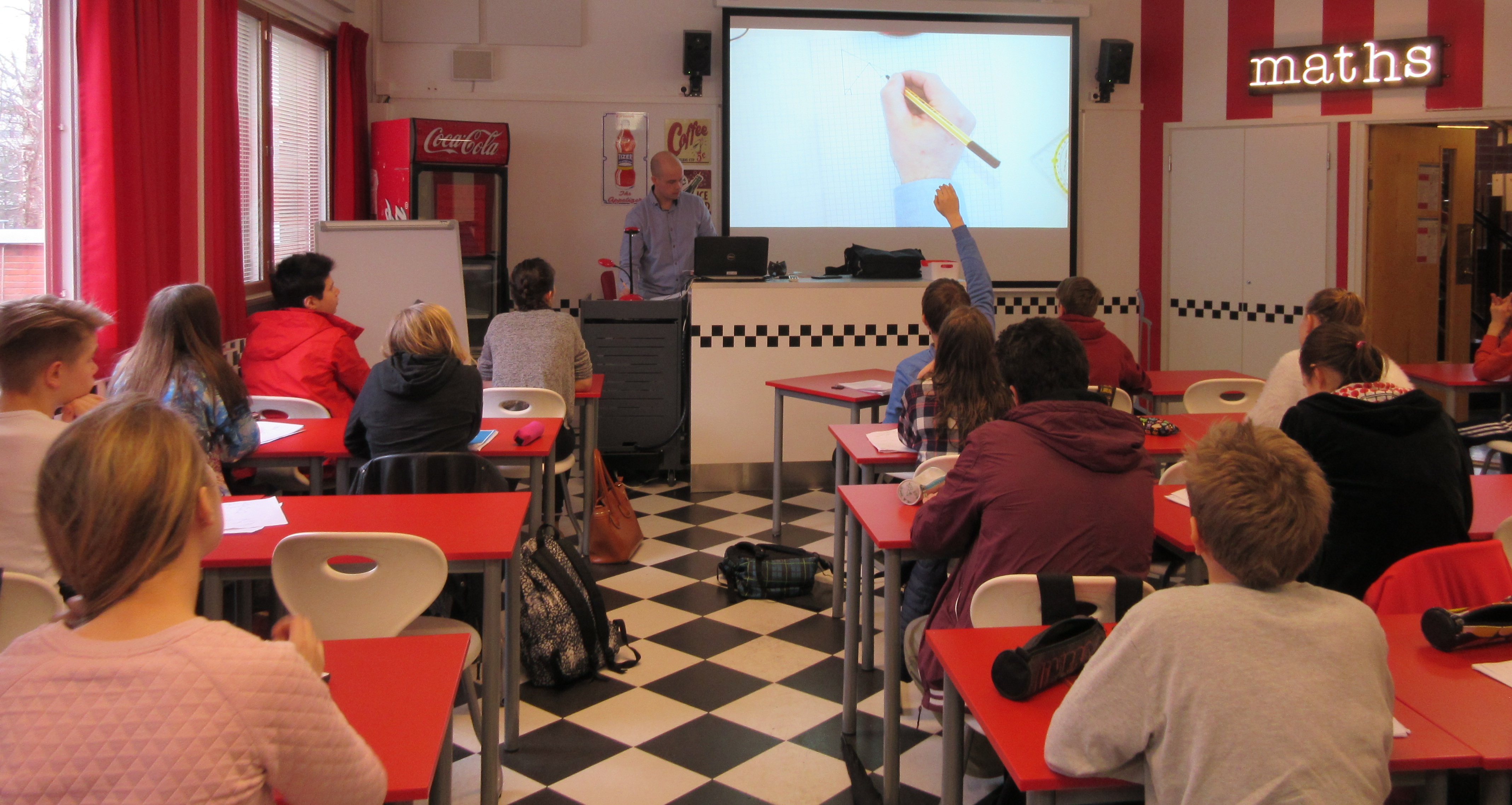
When I left my 7th grade math classroom for my Fulbright research assignment in Finland I thought I would come back from this experience with more inspiring, engaging, innovative lessons. I expected to have great new ideas on how to teach my mathematics curriculum and I would revamp my lessons so that I could include more curriculum, more math and get students to think more, talk more and do more math.
This drive to do more and More and MORE is a state of existence for most teachers in the US….it is engrained in us from day one. There is a constant pressure to push our students to the next level to have them do bigger and better things. The lessons have to be more exciting, more engaging and cover more content. This phenomena is driven by data, or parents, or administrators or simply by our work-centric society where we gauge our success as a human being by how busy we are and how burnt out we feel at the end of the day. We measure our worth with completed lists and we criminalize down time. We teach this “work till you drop” mentality to our students who either simply give up somewhere along the way or become as burnt out as we find ourselves.
When I arrived in Finland I did not find big flashy innovative thought provoking math lessons. I did not find students who were better at mathematics or knew more math content. In fact the Jr. High and High school math classrooms have been rather typical of what I have experienced in Indiana. And most of the struggles (like students not remembering their basic math facts) were the same. The instruction and classroom structure of a math classroom in Finland follows the basic formula that has been performed by math teachers for centuries: The teachers go over homework, they present a lesson (some of the kids listen and some don’t), and then they assign homework. While some lectures have been wonderful and I have gotten to observe some fantastic teachers, I would say that on the whole I have seen more engaging and interactive secondary math instruction from teachers in the United States. It is rare to see a math lesson that is measurably better than those found in my district and I have seen several that were actually far worse.
So, what is the difference? If the instruction in secondary mathematics is the same or sometimes worse than those found in the US, why are Finnish students succeeding and ours are failing? The difference is not the instruction. Good teaching is good teaching and it can be found in both Finland and in the US. (The same can be said for bad teaching.) The difference is less tangible and more fundamental. Finland truly believes “Less is More.” This national mantra is deeply engrained into the Finnish mindset and is the guiding principal to Finland’s educational philosophy.
Less IS more.
They believe it. They live by it. Their houses are not larger than what they need in which to comfortably live. They do not buy or over consume. They live simply and humbly. They don’t feel the need to have 300 types of cereal to choose from when 10 will do. The women wear less make-up. The men don’t have giant trucks (or any vehicles at all, really). Instead of buying hundreds of cheap articles of clothing the Finns buy a few expensive items of high quality that will last for decades rather than months. They truly believe and live by the mentality of less is more.
Conversely in the US we truly believe “more is more” and we constantly desire and pursue more in all areas of our lives. We are obsessed with all things new, shiny and exciting and are constantly wanting to upgrade our lives. Out with the old in with the new! This mentality of “more is more” creeps into all areas of our lives and it confuses and stifles our education system.
We can’t even stick to ONE philosophy of education long enough to see if it actually works. We are constantly trying new methods, ideas and initiatives. We keep adding more and more to our plates without removing any of the past ideas. Currently we believe “more” is the answer to all of our education problems— everything can be solved with MORE classes, longer days, MORE homework, MORE assignments, MORE pressure, MORE content, MORE meetings, MORE after school tutoring, and of course MORE testing! All this is doing is creating MORE burnt out teachers, MORE stressed out students and MORE frustration.
Finland on the other hand believes less is more. This is exemplified in several ways for both teachers and students.
Less = More
1. Less Formal Schooling = More Options
Students in Finland start formal schooling at the age of seven. Yes, seven! Finland allows their children to be children, to learn through playing and exploring rather than sitting still locked up in a classroom. But don’t they get behind? No! The kids start school when they are actually developmentally ready to learn and focus. This first year is followed by only nine years of compulsory school. Everything after ninth grade is optional and at the age of 16 the students can choose from the following three tracks:
• Upper Secondary School: This three year program prepares students for the Matriculation Test that determines their acceptance into University. Students usually pick which upper secondary school they would like to attend based on the school’s specialties and apply to get into that institution. I think of this as a mixture of High School and College. (In recent years a little less than 40% choose this option.)
•Vocational Education: This is a three year program that trains students for various careers as well as gives them the option to take the Matriculation test to then apply for University should they so choose. However, the students in this track are usually content with their skill and either enter the workforce or they go on to a Poly-technical College to get further training. (A little less than 60% choose this track.)
(But wait! Shouldn’t everyone take calculus, economics, and advanced chemistry?! Shouldn’t everyone get a University degree?! No, not everyone has to go to University! Hmmm….. interesting….. What if we provided options for those who want to become successful (and very profitable) welders or electricians? What if we didn’t force students who know that their talents reside outside of the world of formal academics to take three years of high school classes that they found boring and useless? What if we allowed them to train in and explore vocations they found fascinating and in which they were gifted? What if we made these students feel valued and like they had a place in the education realm?)
• Enter the workforce. (Less than 5% choose this path)
2. Less Time in School = More Rest
Students typically start school between 9:00 and 9:45. Actually, Helsinki is thinking of creating a law stating that schools cannot begin before 9:00 am because research has consistently proved that adolescents need quality sleep in the morning. The school day usually ends by 2:00 or 2:45. Some days they start earlier and some days they start later. Finnish students’ schedules are always different and changing; however they typically have three to four 75 minute classes a day with several breaks in between. This overall system allows both students and teachers to be well rested and ready to teach/learn.
3. Fewer Instruction Hours = More Planning Time
Teachers have shorter days as well. According to the OECD (Organization for Economic Cooperation and Development) an average Finnish teacher teaches 600 hours annually or about 4 or less lessons daily. An average U.S. teacher almost doubles that teaching time with an average of over 1,080 hours of in-class instruction annually. This equals an average of six or more lessons daily. Also, teachers and students in Finland are not expected to be at school when they do not have a class. For example, if they don’t have any afternoon classes on Thursdays, they (both teachers and students) can simply leave. Or if their first class on a Wednesday starts at 11:00, they don’t have to be at school until that time. This system allows the Finnish teacher more time to plan and think about each lesson. It allows them to create great, thought provoking lessons.
4. Fewer Teachers = More Consistency and Care
Elementary students in Finland often have the SAME teacher for up to SIX YEARS of their education. That is right! The same teacher cares for, nurtures and tends to the education of the same group of students for six years in a row. And you had better believe that during those six years with the same 15-20 students, those teachers have figured out the individual instructional needs and learning styles of each and every student. These teachers know where each of their students have been and where they are going. They track the kids’ progress and have a personal invested interest in seeing the kids succeed and reach their goals. There is no “passing the buck” onto the next teacher because they ARE the next teacher. If there is a discipline or behavior problem, the teacher had better nip it in the bud right away or else deal with it the next six years. ( Some schools in Finland only loop their elementary children for three years at a time instead of six, however the benefits are still the same. )
This system is not only helpful to a child because it gives them the consistency, care and individualized attention they need, it also helps the teachers understand the curriculum in a holistic and linear way. The teacher knows what they need to teach to get them to the next step, while also giving the teachers freedom to work at the pace of their students. Teachers don’t feel the pressure to speed up or slow down so that they are “ready” for the teacher next year. Again, they are the teacher next year and they control the curriculum! They know where the kids are and what they have learned and will plan according to the students’ needs! I really believe this is a HUGE part of Finland’s success story and it does not receive enough attention.
5. Fewer Accepted Applicants= More Confidence in Teachers
So……children have the same teacher for three to six years. What if your kid gets a “bad teacher”? Finland works very hard to make sure there are no “bad teachers.” Primary education is THE most competitive degree to get in Finland. The elementary education departments in Finland only accept 10% of all applicants and turns down thousands of students annually. A person not only has to be the best and the brightest to become a primary teacher, they also have to have passed a series of interviews and personality screenings to get in. So, it isn’t enough to be the smartest in your class, you also have to have the natural ability and drive to teach.
Finland understands that the ability to teach isn’t something that can be gained from studying. It is usually a gift and passion. Some have it, some don’t. The few universities with teaching programs in Finland make sure they only accept applicants that have that gift. On top of excellent grades, and a natural disposition to be a teacher, all teachers must get a Master’s degree and write a Master’s Thesis. This generates a lot of confidence and trust in Finland’s teachers. Parents trust the teachers to be highly qualified, trained, and gifted individuals. They do not try to interfere or usurp their authority and decisions. I asked a math teacher how many emails they typically get from parents. They shrugged and answered “About five or six”. I said, “Oh, I get about that much a day too.” They then answered…”No! I meant five or six a semester!” Again, what would it be like to live in a society based on trust and respect?
6. Fewer Classes= More Breaks
As I stated before, students only have three to four (or rarely, five) classes a day. They also have several breaks/recesses/ snack times during the day and these usually happen outside come rain or shine. These 15 to 20 minute gives them time to digest what they are learning, use their muscles, stretch their legs, get some fresh air and let out the “wiggles.” There are several neurological advantages for these breaks. Study after study supports the need for children to be physically active in order to learn. Stagnation of the body leads to stagnation of the brain and unfocused, “hyper” children.
The teachers also have these breaks. The first day I was in a school in Finland a teacher apologized for the state of the “Teacher Room.” She then commented on the fact that all teacher rooms must look like this. I laughed and politely agreed, but in my head I was thinking; “What is a teacher room?” A teacher’s room is what used to be called the teacher’s lounge in the U.S…back before they went extinct. In Finland these rooms are always full of teachers who are either working, preparing, grabbing a cup of coffee, or simply resting, socializing, and mentally preparing for their next class.
Secondary level teachers usually have 10 to 20 minute breaks in between classes and often have a few skip (prep) periods as well. These rooms are different depending on the school, but from what I can tell the basic formula is a few tables, a few couches, a coffee pot, a kitchen, a selection of free fruit and snacks, and teachers to talk and collaborate with. A few of them even have massage chairs! Ha!
So, why don’t these rooms of collaboration, support and solace exist in the U.S.? We do not have TIME! Every day we teach six to seven classes in a row with no breaks. The three to five minute passing periods we do get are often used to answer emails from parents, erase the board, get ready for the next class, make copies, answer student questions, pick up the mess left behind by the students, and (heaven forbid) go to the bathroom! If we have a spare moment we are then expected to monitor the hallway because we can’t trust students to get to class without supervision. The luxury of actually sitting down for 10 minutes and enjoying a cup of coffee with some colleagues is an absolute dream, and having a day with only three classes—that is a fantasy!
7. Less Testing = More Learning
Imagine all of the exciting things you could do with your students if there wasn’t a giant state test looming over your head every year. Imagine the freedom you could have if your pay wasn’t connected to your student’s test scores. Imagine how much more fun and engaging your lessons would be!
Although it still exists, there is overall less pressure on the teacher in Finland to get through the curriculum. The teacher is simply trusted to do a good job and therefore they have more control over their classroom and its content. The teacher is able to take more risks and try new things and create exciting, engaging curriculum that allows students to become skilled individuals ready for the real world. They have time to teach skills that allow students to develop into individuals who know how to start a project and work systematically to accomplish a goal. They have time to teach craft education where students get to learn how to do real life skills like sewing, cooking, cleaning, woodworking and more! And while they are learning these amazing skills they are also learning math and problem solving and how to follow directions!
8. Fewer Topics = More Depth
I have observed several fifth through ninth grade math classes in Finland. I have looked at the curriculum covered over these five years of education and I realized that I attempt to teach the content of five years of Finnish math education in one year. Each math topic presented in every grade level I have observed here is include in my seventh grade curriculum.
Again, the American mentality of “more is more” simply does not work. If I am to get through everything I am expected to do in one year I have to introduce a new topic/lesson every other day and I always feel “behind”. Behind what, I am not sure, but the pressure is there pushing me and my students along. In Finland, teachers take their time. They look deeper into the topic and don’t panic if they are a little behind or don’t cover every topic in the existence of mathematics in a single year.
Also, students only have math a few times a week. In fact, after Easter Break, all of my seventh graders only have math ONCE a week! My heart still panics a little when I hear this! I can’t believe that is enough math time! How will they be ready for the tests?! Oh— wait. There are no tests. There is no need to rush through. The students get to actually understand the material before they are forced on to a new topic. One teacher showed me a course book and said that it had too many topics for one five week grading period. I looked at the entire book and had to stifle a chuckle because it essentially covered what would be found in ONE chapter from my textbook. Why do we push our kids in the U.S. to learn so much so quickly? No wonder they are stressed out! No wonder they give up!
9. Less Homework = More Participation
According to the OECD, Finnish students have the least amount of homework in the world. They average under half an hour of homework a night. Finnish students typically do not have outside tutors or lessons either. This is especially shocking when you realize Finnish students are outscoring the high performing Asian nations whose students receive hours of additional/outside instruction. From what I can observe, students in Finland get the work done in class, and teachers feel that what the students are able to do in school is enough. Again, there is not pressure to have them do more than what is necessary for them to learn a skill. Often the assignments are open-ended and not really graded. Yet, the students work on it in class diligently. It is very interesting to see what happens to the students when they are given something to do. The students who were not listening to the lesson at all put away their phones and start working on the task set before them. Even if it is just a suggested assignment, they give it their full attention up to the end of class. It is almost like there is an unspoken agreement: “I won’t give you homework if you work on this while you are in my classroom.” This system has really made me think about the amount of homework I assign on a daily basis.
10. Fewer Students = More Individual Attention
This is obvious. If you have fewer students you will be able to give them the care and attention they need to learn. A Finnish teacher will have about 3 to 4 classes of 20 students a day- so they will see between 60 to 80 students a day. I see 180 students every single day. I have 30 to 35 students in a class, six classes in a row, 5 days a week.
11. Less Structure = More Trust
Trust is key to this whole system not structure. Instead of being suspicious of one another and creating tons of structure, rules, hoops and tests to see if the system is working, they simply trust the system. Society trusts the schools to hire good Teachers. The schools trust the teachers to be highly trained individuals and therefore give them freedom to create the type of classroom environment that is best for their individual students. The Parent’s trust the teachers to make decisions that will help their children learn and thrive. The Teachers trust the students to do the work and learn for the sake of learning. The Students trust the teachers to give them the tools they need to be successful. Society trusts the system and gives education the respect it deserves. It works and it isn’t complicated. Finland has it figured out.
Less IS More.

 Filling My Map
In Finland the public education system is fully funded by the country. If a student wants to attend the University, all they have to have is the aptitude. There’s no huge tuition bill. It’s covered by the country. I visited Finland schools for a week. I agree with many of the points in the article. We could learn alot from them. Two quick fixes would be to start the day later and finish earlier.
LikeLike
Along with the 15-20 minute breaks between some classes. Long ago we used to call them recesses.
LikeLike
Pingback: Less can be more in education | Lake Travis Parents
Looking forward to your blog.
LikeLike
Thanks for the outsider’s view!
The number of applicants for the upper secondary (lukio) and vocational school
are the other way around:
62% vocational
38% upper secondary
(Finland Ministry of Education, 2014)
http://www.oph.fi/ajankohtaista/tiedotteet/101/0/uudet_opiskelijat_valittu_ammatilliseen_ja_lukiokoulutukseen
LikeLike
Thank you! I will fix right away.
LikeLike
She says 60 percent vocational and 40 percent secondary, no?
LikeLike
Hi!
Just two small remarks…the teacher doesn´t necessarily stay with the same group for six first years, it depneds on the school.
Second…did you mean buck or puck 😉
LikeLike
“Pass the buck” is an English expression. http://www.phrases.org.uk/meanings/pass-the-buck.html
LikeLike
Yeah, but Finland is the land of hockey!
LikeLike
Having taught in finland in 1998 i can agree with everything stated in this article. The the biggest problem i had was getting the pupils out of the class at the end of the day (2.30) as if they had any work left over they would sit in the classroom and finish it. Its just so much more focused and relaxed than here in the uk.
LikeLike
Such an eye-opener. I strongly believe that government (as well as culture) plays an important part in it all. For example, in Mexico, where I currently live, it would be a great challenge to go that way; however, I can choose imporant points mentioned in this article which I can apply to my teaching practice in order to be better and help my students succeed.
LikeLike
Reblogged this on Kansans Against Common Core and commented:
It’s rare that I like what Europe is doing or think what they are doing is better. However, there are many things about the way things in Finland work that just make sense. Kelly writes, in part, “Students in Finland start formal schooling at the age of seven. Yes, seven! Finland allows their children to be children, to learn through playing and exploring rather than sitting still locked up in a classroom. But don’t they get behind? No! The kids start school when they are actually developmentally ready to learn and focus. This first year is followed by only nine years of compulsory school. Everything after ninth grade is optional and at the age of 16 the students can choose from the following three tracks…”
LikeLike
Many are not aware, but in more rural areas of the United States, requiring consolidated school districts and extensive bus commute, there are schools that do not start kids until age 7, and by 8th grade, they are completely even with their counterparts who went to pre-school starting as soon as the need for diapers is over. It has also been shown that the edge given by head start programs is short term and that these children, even with special enrichment, are once again at the norm for their age group by 3rd or 4th grade. But I would further suggest that instead of using age as the boundary marker, we should develop tests to measure emotional readiness to learn, and allow children to enter school as their ability permits. By taking the age thing out of the equation, we would eliminate a whole lot of the artificial notions of what constitutes normal learning. Instead of saying that a 6 year old should have mastered this or that, we would be focusing on the progression. A first grader must master this or that to move on to the second grade-age is not the determining factor, but skills mastered.
LikeLike
I wouldn’t recommend tests after tests after tests, but in fact, here in Finland we do have school maturity tests. Not for everybody, but for those expected by our maternity clinic system (which actually hands over the infants to the school system – and sometimes the Health Care person doesn’t even change!) to may have difficulties entering the first grade. It is possible to start school at the age of six, or delayedly at the age of eight. These are still normal school starting ages, and may not have any special aid consequences; the child that has started at the age of eight may gain up in time.
Then again, it’s not uncommon that children “double” the first class, if they are found unmature. This is propably the most usual point to remain in the class. Often these kids do averagely or well afterwards.
LikeLike
Hi,
I’ve been working as a language teacher in Finnish upper secondary school (senior high schools) for more than 30 years, and I can assure you that students at that level have A LOT of homework. If they do what they are expected to do, it will takes them several hours per day. Also, our six-period system (the schedule changes every six weeks, with tests in all the subjects at the end of a 6-week-period) is very stressful for both students and teachers. I have also had two kids who have both been to upper secondary school, so I have seen the workload as a parent, too. I don’t know in what Finnish schools they do only 30 minutes of homework
LikeLike
In Primary schools if you’re a kid without any learning difficulties, it rarely takes more than 30 minutes to do the homework and often less, especially if you have homework only from Math and Finnish like in the first and second grades.
LikeLike
This writing was about primary and secondary school, not about upper secondary. Upper secondary is clearly more demanding, yes.
LikeLike
In the lower grade of the comprehensive school… In the upper grade they already have homework from (practically) every lesson, and they have classes for 30 hours a week – that makes 6 per day, not 3-4. But what we should learn from this very meritorious blog: we should follow our own path, not take from the countries who, in fact, do worse than we in general. Yes, we teachers may complain about lazy students who only listen to music and don’t want to learn… but what is the alternative? And we certainly have enough (Kokoomus-)politicians, who want to take after the US or Sweden, never mind all the PISA researches. We who work in the schools should thank the PISA for the peace it has provided us! However much we know should be corrected in our system, too.
LikeLike
100% agree with your comments Inga-Lill Till. The amount of homework is huge and the enormous number of continuous exams is truly staggering – far more than I had at University which was supposed to have the most exams in any University in my homeland.
In addition, the WILMA system (computerized-school network) is over-used – I would estimate that 95% of the “feed-back” coming from the school –> home is all negative and totally unnecessary, particularly in relation to the most ridiculous trivial matters. Several teachers I have spoken to agree fully with me on this point.
The overall thrust of the article “Less is More” is definitely one of the very positive aspects of Finnish life in general – but does not extend to homework or the amount of exams.
LikeLike
I’m a former student of the school/schools that you write about and currently taking Education at the university level. Along with the points made earlier I have to add something as well:
Results from the matriculation exams, in most cases, don’t determine whether you get to go to a university, entrance exams do. Past grades may be part of the elimination process but usually isn’t the only factor. Entrance exams test both your know-how as well as your motivation to get into the program you’ve applied to. This applies to Teachers’ Ed as well.
Testing does also take place on lower levels. There’s usually one exam (or essay/project) at the end of every course, both in primary school as well as in lower and upper secondary. Upper secondaries even arrange exam weeks at the end of every study period, so every student is expected to take the test and pass it in order to get a grade for the course they’ve signed up for.
School days may start at 8am and last until 4pm. Most of my school days in upper sec were like this without any extra curriculars. Class sizes vary between 20-25 in most cases. In upper secondaries they can amount up to 50. Outside breaks are only compulsory for primary school students, most lower and upper sec students choose to spend their breaks inside. And primary school kids may have several teachers as well – one that teaches most subjects and a few others who teach the rest of the subjects. Naturally these all vary according to the school in question, but just a few remarks from my own experience in the schools you visited 🙂
I spent my last semester in North-America observing the uni level education…interesting to hear your point of view!
Best regards to my former maths teacher, you’re the best!
LikeLike
Pingback: I’ve been saying this for a long time. | Ferat-isms
Being from Finland and having attended school there, the education is the best. One thing in my living in the US and seeing my daughter go through school here is the learning the English language. Once a student in Finland has been in school one or two years they don’t have a problem with spelling. Now they can learn any subject.
LikeLike
Hah, how familiar experience 🙂 We lived about 3 years in US, our kids going to school from kindergarten to 5th grade. If I recall right, they had to practice spelling even at 5th grade. But we Finns benefit from having a phonetic language so once you learn to write (often already before the 1st grade), you are generally able to write anything in Finnish language. So we have more time to focus on real learning of other subjects. And I would add that the metric system vs. imperial is a great advantage to us as well. E.g. You can be “1.72 meters” or “172 centimeters” tall, instead of “5 feet and 7 inches” or “67 inches”. See the difference? 😉
LikeLiked by 1 person
When you grow up with the metric system, you actually visualize your world perception in terms of metrics. Those numbers, in their orderly and divisible by ten mode, have a real meaning for you visually, and perceptually. For Americans, telling me that somebody is 172 centimeters tall is not something that I visualize, and in order to do so, I would have to convert it to the feet/inches to have any frame of reference. Much like learning a foreign language, there has to be a comparative that you are familiar with or the words have no meaning. In learning the grammar of a foreign language, you are comparing and contrasting to the grammar you know. Frame of reference depends upon what you grew up with as the accepted normal.
LikeLike
Pingback: More is less? | maxeneborg
A beautifully written article.
I am a practising teacher/administrator from India, from the CBSE curriculum. I had the opportunity to visit Finland in 2012 and sit through/observe all levels of education from pre primary to a masters in education class. What struck me most was the way education and community have integrated with each other, the mutual sharing of resources: material and human, the complete hand holding between the education system and industry.
The lack of pressure was distinctly felt by me, more so because I work in a system which holds marks and grades as top priority.
In my brief meetings with various stakeholders, the complete integration between each other was totally obvious.
Finland definitely has a lot to offer to the education systems of the world.
LikeLike
ad it was of course 18/ 100000 boys, not girls again…
LikeLike
Reblogged this on The Mind of Ana and commented:
11 Cara Finlandia Mengajarkan bahwa Less is More dalam pendidikan
(terjemah bebas)
1. Less formal schooling
Sekolah dimulai saat anak berusia tujuh tahun, yaitu saat mereka mampu untuk fokus dan siap untuk belajar. Sebelum usia tujuh tahun, anak dibiarkan menikmati kehidupannya sebagai anak-anak. Saat usia mereka 16 tahun, mereka memiliki tiga pilihan: pertama masuk ke sekolah selama tiga tahun untuk persiapan kuliah yang dipilih oleh kurang dari 40%, vocational education semacam sekolah menuju jenjang karir tertentu yang dipilih oleh kurang dari 60%, terakhir ada yang memilih langsung bekerja yaitu kurang dari 5%.
2. Waktu yang dihabiskan di sekolah minim = banyak istirahat
Kelas dimulai pukul 9.00 dan 9.45, ini dikarenakan menurut penelitian anak anak membutuhkan tidur yang berkualitas di pagi hari (yes please). Sekolah berakhir pada pukul 2.00 atau 2.45. Setiap hari mereka memiliki tiga sampai empat jam pelajaran, setiap jam pelajaran adalah 75 menit, ada istirahat di antara pergantian jam-jam tersebut.
3. Fewer instruction hours = more planning time
Rata-rata guru di Finlandia mengajar empat jam sehari atau 600 jam per tahun, guru tidak harus semua datang pada satu waktu. Kalau jadwal mengajar pukul 11.00 maka guru tersebut tidak perlu datang sedari pagi. Waktu sebelum mengajar dapat dimanfaatkan untuk mempersiapkan bahan mengajar dengan lebih baik.
4. Guru lebih sedikit = More Consistent and Care
Dalam setiap kelas yang jumlahnya 15-20 anak, gurunya tidak berubah selama mereka SD. Jadi gurunya sama sampai mereka lulus. Guru mampu mengetahui kebutuhkan pendidikan setiap anak, gaya belajar mereka, dan memiliki keinginan untuk melihat anak anak tersebut sukses yang sesuai untuk masing-masing anak. Jadi guru mampu melihat kurikulum secara holistik, mereka tidak risau untuk menghabiskan materi tahun ini karena mereka pula yang akan mengajar tahun seterusnya. Di sinilah guru mampu menyesuaikan ritme belajar sesuai kemampuan masing-masing anak.
5. Guru yang diterima sedikit = Percaya diri guru lebih tinggi
Bagaimana kalau ada guru yang jelek selama enam tahun? Finlandia berusaha sangat keras untuk memastikan guru SD bermutu. FYI, Primary education (kuliah untuk menjadi guru SD) adalah sarjana yang paling kompetitiv masuknya. Hanya ada 10% yang diterima masuk ke jenjang tersebut dan yang lainnya ditolak tiap tahunnya. Seseorang yang diterima tidak hanya yang paling pandai dan pintar tapi juga melalui tes wawancara dan kepribadian . Jadi tidak hanya pintar tapi guru tersebut juga memiliki kapabilitas dan kemampuan untuk mengemban pelajaran.Orang tua wali murid sendiri sangat respect dan percaya dengan guru seperti ini karena mereka tidak hanya mampu secara akademis namun juga “gifted”. Sampai bila ditanya guru tersebut hanya mendapatkan lima sampai enam email per semester, dibandingkan di US guru setiap hari menerima lima sampai enam email.
6. Jam pelajaran lebih sedikit = istirahat lebih banyak
Istirahat disela jam pelajaran merupakan waktu di mana anak-anak menyerap pembelajaran tersebut. Mereka meregangkan otot, memakan snek, menghirup udara segar, dll. Biasanya waktu istirahat ini adalah 15-20 menit. Penelitian menemukan bahwa anak-anak membutuhkan gerak fisik untuk belajar di kelas. Bila tubuh berhenti bergerak (duduk terlalu lama, stagnan) maka otak juga stagnan, tidak mampu fokus dan anak menjadi hiperaktif.
Tidak hanya murid yang istirahat, tapi guru juga istirahat. Ruang guru terdiri dari sofa, dapur, mesin pembuat kopi, snek, buah, kursi dan meja meja di mana guru bisa istirahat, mengobrol, dan mempersiapkan bahan mengajar untuk kelas selanjutnya. Malahan ada ruang guru yang lengkap dengan kursi pijat juga 😀
7. Less Testing = more learning
Kalau guru tidak dihantui dengan tes dan tes, maka guru mampu mendesain pembelajaran yang jauh lebih menyenangkan. Dalam kelas menjahit ada unsur belajar matematika, menggambar pola, dll. Guru diberi amanah untuk bekerja mentransfer ilmu secara lebih baik. Mereka mampu membimbing anak mengerjakan yang dia suka, bagaimana memulai suatu proyek sederhana, dan memberi guidline untuk mengerjakan proyek tersebut.
8. Fewer topic = More depth
Alih-alih berkeinginan mengajar banyak tema/bab dalam satu waktu, Finlandia menyederhanakan tema tersebut menjadi hanya beberapa. Guru di sana take their time untuk mengajar bab tersebut, tidak panik kalau lambat atau ada bab yang ketinggalan. There is no need to rush simply because there is no test! Itulah mengapa kalau kebanyakan bab yang anak dipaksa harus cepat belajar, maka mereka akan mudah menyerah, panik, dan stres. Ya stres!
9. PR Sedikit = partisipasi lebih banyak
Kalaupun ada PR maka bisa dikerjakan dalam waktu 30 menit dan kebanyakan tugas diselesaikan di sekolah. Mereka juga tidak memiliki tambahan pelajaran seperti les atau cram school seperti di kebanyakan negara Asia. Namun mereka mampu mengungguli skor performance negara Asia yang memiliki sistem les sepulang sekolah. Walau begitu anak Finlandia siap menerima tugas di kelas, menyelesaikan tugas tersebut sepenuh hati, dan semacam ada peraturan tidak tertulis “selesaikan di sekolah maka tidak ada pekerjaan di rumah”. Guru juga tidak menjejali dengan kerja ekstra, intinya asalkan mereka memahami konsep, maka bagus mengerjakan pekerjaan tambahan, pekerjaan tambahan itu ada juga yang tidak dinilai tapi anak-anak tetap mengerjakannya dengan baik.
10. Sedikit siswa = banyak perhatian
Membayangkan satu guru mengajar 4 jam perlajaran, di kelas yang berbeda, setiap kelas isina 20 anak. Maka guru tersebut per hari menjumpai 80 anak yg berbeda.
11. Less structure = more trust
Dari pada fokus pada struktur, tes, dll. Finlandia mempercayai sistemnya dan melihat apakah berhasil. Masyarakat percaya pemerintah akan menyaring guru yang bermutu, dan memberikan kebebasan mereka untuk berkarya. Wali murid percaya guru akan membuat keputusan supaya anak mencapai keberhasilan. Guru percaya bahwa muridnya akan melakukan pekerjaannya agar mereka mampu belajar. Pelajar percaya bahwa gurunya akan memberikan bahan yang tepat untuk membuat mereka berhasil. Masyarakat menghargai sistem tersebut dan memberikan penghargaan pada pendidikan.
Less is more.
https://fillingmymap.com/2015/04/15/11-ways-finlands-education-system-shows-us-that-less-is-more/
LikeLiked by 1 person
Pingback: 11 Ways Finland’s Education System Shows Us that “Less is More”. | The Mind of Ana
I’m a Malaysian who once went to university in the US. When I saw what was taught in the Maths/Algebra class, I had to stifle a laugh. We did that when we were in 7th grade. If Asian ‘study robots’ don’t do as well in standardised tests, it’s because only the rich get to go to good schools with good teachers and go for extra tutoring after school. The rest just fall behind because their parents don’t care about education or can’t afford extra tutoring for them. Most people in Malaysia become teachers because they can’t get other jobs, so having attended school with a syllabus 10x that of the US doesn’t mean you’ll score 10 times higher due to all the above factors.
LikeLiked by 1 person
Thank you for the article. I’m North American teacher currently teaching in international branch of Chinese school in China. Philosophy here seems to be more is more (students typically in school from 730 am to 5 pm) plus TOEFL and SAT prep classes after school and on weekends and holidays. I would be curious to see how China and Finland stack up to each other. No doubt the teaching is much better in Finland – in China I often see the Chinese teachers drone on for hours while students sleep away.
LikeLike
About maths. I belive teaching math too much too fast is counterproductive.
A math teacher once explained it like this:
learning math is like building a house. You start with the base and start to build upwards. If the previous structure is weak then the next won’t be any better. And it’s very hard to build on a lacking foundation. So if you don’t build your house carefully one step at a time it won’t be easy nor good.
The same applies to maths. What’s the point rushing to build your mathematical house to only see it fall down because the structure was weak and had even holes in it!!
About the article. Very good and nice insight.
I’m not a teacher but as
a Finn I have few.corrections and most are probably mentioned in these comments already.
The matriculation exam is not mandatory to get into University. If you have a secondary school degree(vocational or upper secondary) you can apply to university. They have entrance exams. To some University programs you can get in by scoring well in your matriculation exam. But you can also try with the entrance exam. Also to some pprograms you need to take an entrance exam no matter what.
Also. Many students go to polytechnic(University of applied sciences) after upper secondary school and getting ther matriculation exam. Many degrees that are taught in universities in states are taught in Polytechnics in here. Like nursing, engineering and others.
LikeLike
Great post! Always thought that our problem here in the US is our preference for quantity over quality.
LikeLiked by 2 people
Reblogged this on Doraemon's pocket and commented:
Repost and mark
LikeLike
Pingback: Running away to Finland | laurenn7
Kelly, thanks for your nice blog. Of course many things in Finnish education system are good, and mostly what you presented, but at the same time, not everything is perfect. We lived a few years in US and our kids went to school from kindergarten to 5th grade so I guess I have enough experience to argue 🙂
I remember when 2009 PISA rankings were published, there was someone highly ranked in US education system (maybe Secretary of Education) interviewed for TIME magazine, and one of his main recommendations was to look for how much more they work (homework, extra tutoring etc.) in South Korea (which was the second or so just before Finland in the rankings). But he didn’t bother to mention how much LESS we work in Finland 🙂 So you may work very very hard, and gain good results – at least at official testing, or you may work much less and still gain pretty good results 😉 I’d prefer working less and thus allowing more social life, playing with their friends and other fun things our kids can do in Finland, instead just studying around the clock.
On the other hand, Finland has dropped in PISA rankings quite remarkably recently, and one explanation is the lack of homework.
http://www.businessinsider.com/why-finland-fell-in-the-pisa-rankings-2013-12?IR=T
So I would say it’s not right to just look at one factor and make conclusions based on that, but instead look at it as a whole. So I’m grateful you wrote up about your list of 11 different things (which were mostly accurate, but other Finns have already commented about some differences). I think the basis for our success is there, the whole system.
I would add one thing though. Our country is quite safe, our kids can usually walk/bike to/from school w/o worrying about safe school trips, and after school they can go out and play with their friends quite free. So lots of play, play, play without pressure to do more, more, more homework 😉
LikeLike
I am curious. Usually education is designed to prepare you for life, for the adult life you will lead in your society. In the United States, we would do our children a great disservice to allow the amount of breaks and downtime, to allow the lesser amounts of homework….It is not reflective of the work world that they will be entering, not the expectations of employers. Our education system reflects our entire work culture, and changing one without corresponding changes to the other would create hardship for the workers.
We work more hours than any other industrialized nation. We have less holidays, time off, vacation than our European counterparts, and our school system is structured along those lines. In fact, one of the hardest adjustments, post education, for our students entering the world of work, is the notion that you get almost 3 months off every summer and 2-3 weeks of holiday at Christmas/New Year. Our typical workday includes two 10-15 minute breaks and a half hour lunch if lucky. Teachers are no different than people working in other industries. Any and all personal business, phone calls, etc are expected to be confined to those breaks and lunch periods. Most folks that I know have the constant cup of coffee at their desk, rather than going to a “lounge” area.
LikeLike
Takeing into consideration chilrdrens mental capacity and ability to concentrate.
I argue that having 10-15 minute breaks every 45 minutes makes kids more productive and focused for the time they are learning then not having breaks at all or more seldom. Having these breaks lets them “blow some steam off” and go out, get fresh air.
Also kids live in the “real world” too, being a kid is as real and serious as being an adult. And there’s lot to learn besides how to do work. There will be plenty of time for kids to learn how things work in “work life” when they are a bit older.
Here in Finland (dunno about Europe in general because there are loads of different ways depending of the country..) we get 1 – 1,5months off during summer. Also a week or so during Christmas time. So compared to school, which is 2-3months during summer and 2-3weeks during Christmas time. The break times are about the same in here, varying a bit depending of the job.
LikeLike
I couldn’t edit my previous post to add to it.
I wanted to mention also this.
In schools kids learn a lot of stuff besides what is taught in the classroom. Even the breaks serve as important lessons for social skills that can’t be taught in a classroom setting.
Also the litte spats and hassels kids have in the playground are a great way to learn how to handle those kinds of situations.
Also, I’m wondering on what fact you base your statement that US workers work most hours then any other in industrialized nations?
To my understanding in US they have the “40 hours week” system, in which the weekly work hours are kept around 40 hours. And according to the annual work hours aren’t that much higher then compared to many other countries, though surely on top side.
(https://stats.oecd.org/Index.aspx?DataSetCode=ANHRS#)
LikeLike
Until the fall of our trade exchange with Russia (for obvious reasons), Finland was on top of the list of competitiveness and known for good austerity. Even though we know how to take it easy… maybe we are just so effective between the breaks! (That’s likely.) Finns are known to be hard workers, and I guess the wisdom is in knowing when to work and when to have a break. And not having a break while working, as in many other cultures.
LikeLike
I would seriously argue against your comment that it would require more work at schools in U.S. because they are required to work more as adults. I mean, how in earth was I able to succeed very well in US work environment with my background from Finnish “more relaxed” school system 😉 Besides, there have been numerous studies done on how children’s brains need lots of rest in order to develop well. So less is more is really valid especially in the lower grades.
LikeLiked by 1 person
The reason behind the low acceptance rates to the elementary education departments is more complicated than you think. In general, persons who are less mathematics, logic, and science inclined, and can’t even dream about applying to medical, technology, law, science, or economics, often apply to elementary education departments. Like elsewhere, the best and brightest apply for programmes which lead to highest pay jobs, and teacher isn’t one of them.
Finland also has some problems with mathematics teaching in upper secondary school. It’s not as popular as it should, partly due to no-so-special math teaching throughout all the levels of education. This leads to shortage in mathematically inclined students to fill all the positions in technical and science universities, which causes very high acceptance rates, although almost none of the future teachers stand a chance to get in to those. This problem also feeds itself because the material coming to mathematics teaching programmes is quite mediocre.
One of the questions to ponder is: does sex matter? 6 first years you’re likely to have a female teacher. After that you’ll probably have a male math and science teachers. When you pass matriculation examination, boys are more likely to choose math and technology oriented studies which are constantly short of students, and girls apply to become teachers, in masses. What’s the reason for that?
I’m not saying the material applying for elementary education is bad, but just a bit over the average. And the what’s average in Finland is pretty good after all.
LikeLike
Why doesn’t anybody mention the obvious explanation? For all types of social organizations (from kindergartens to graduate schools to startups) the quality of the output (what people can accomplish after the organization works on them) relates most strongly to the quality of the input (how well prepared the people were coming in). Finland is more or less monocultural. I don’t know how they treat their young children but I bet they are read to and loved and treated well. The result is students well prepared to learn. As the Harvard Preschool Project showed many decades ago, success starts early in life. The author nearly arrives at this conclusion when she observes that the teaching really isn’t much different, but then she uses her observations to go on a long digression about favored lifestyle changes. No harm done except she missed the real explanation I think.
LikeLike
A very good point.
What parent’s do with their kids or what they don’t are pretty much up to them before school.
I mean on the terms of prepareing for school/education. I’d like to say most kids are read to, loved and treated well. Of course there’s exceptions to it, which is sad. But an unfortunate fact of life.
Most finnish kids can read and write before entering school but not all, most learn it in the first grade if not before. Usually if you can’t at that point you’ll receive extra attention to learn it.
LikeLike
Reblogged this on Life on the e-line and commented:
In the hurried busyness of NCEA, the lesson of less is more is hard to conceive. We’ve taught our students to be credit hungry, our universities are requiring evidence of high achievement equating to credits and parents want the best for their children. When and how do we say, enough is plenty? Why do we make them accumulate credits over three years when one is enough? Surely good learning is not good learning and does not need the added weighting of credits?
LikeLike
Pingback: Thought Provoking Thursday: Is Less More? | United Christian Homeschoolers of the Upstate (UCHU)
Hi Kelly, This is wonderful to hear so many great ideas you learned from your time in Finland. With your permission, I would like to link and feature this post in one of my upcoming Awesome Stories series.
Thanks, Brad
LikeLike
Yes! I would be honored.
LikeLiked by 1 person
Thanks!
LikeLike
Loved reading your blog. As I read through each point I felt myself becoming calmer and calmer…….and the idea of teaching in Finland very appealing! Except my Finnish is zero!
LikeLike
I found your insights very interesting, but once again, the success of the system depends upon the entire social fabric. Finland is a much smaller nation, and as such, probably much more homogenous than the United States. As you travel through the United States there is such a wide panorama of cultures, and even within communities, a greater diversity of population to be served. The population of children served by public education alone, in the United States, probably dwarfs the entire population of Finland. Things that work on a small scale of people with similar backgrounds, goals and values does not always translate to a larger arena. While we might be able to extract some good principals, I don’t think that the entire format would translate.
I would wholly agree with the notion that our system does not allow sufficient time for a program to show its true worth, but yet again, we cling to things that have clearly proven less than effective. There is a certain element of solutions piled upon solutions, and the overlaid programs can negate the value of one another in that they are not complimentary, but contrary.
LikeLiked by 1 person
You’re right about Finland being more homogenous than the US (certainly!) but even Finland is not entirely homogenous at all. If you have followed Kelly’s ideas, you might come to the conclusion, that the Finnish school system is just taking into account all the different learners. Maybe the US school system should do that the third power, at least!
What, in general, and despite the approach, are elementary factors in a successful child education: TIME and TRUST!
LikeLike
Our principle, deriving from our history and made living in our school, would be: “Kaveria ei jätetä” – Don’t leave your mate behind. I think one of the strenghts of the Finnish school system (which Kelly hasn’t mentioned yet) is that it takes very good care of the weakest and tries to save all potential drop-outs.
LikeLike
Wow, this has really opened my eyes to what I could have for my own children, I battle with this ideal constantly! As a teacher and mother in the UK I have first hand experience of what it looks like. Here we are definitely driven by more is more too. As teachers (and as a parent), I find myself constantly sharing notes with other teachers (and parents), who always appear to be doing it better than me! I teach a curriculum that I am told to teach, in a timescale that is always far too short, seeing 150 kids a day, with a half hour lunch at my desk (we lost our staff room almost two years ago, so that the sixth form had somewhere to go!), I set plenty of homework because that is our policy? I often look at the stressed out faces of children not wanting to let me or their parents down, in the endless pressure to achieve their targets!
LikeLiked by 1 person
Pingback: Less is More! | My Adventures in PIDP
Absolutely on target. I’ve written a book and the title says it all. “Just a Little Bit More: The Culture of Excess and the Fate of the Common Good.” Ever since the days of Rockefeller, American society has been pursuing more and more. Some of the time it works and is beneficial. Not all the time – and we suffer for it, even in our classrooms. http://justalittlebitmorebook.com/
LikeLiked by 1 person
Awesome!
LikeLike
One of the things that provides biggest rewards in the Finnish school system is often missed in these lists. I’m referring to early diagnosing of learning difficulties. Finnish teachers use quite advanced methods in that area. Learning difficulties are tackled with extra resources. Those students aren’t usually removed from their class. Instead they receive extra help, whether it’s a TA during class or some specialist tackling the difficulty in a personalized instruction session. Some students that receive extra help might get back on track in only a few weeks. No matter how long it takes or even if it requires constant support, it’s very important to catch these things that affect learning sooner rather than later. Little extra spent early on is definitely worth if it means less struggle for the rest of the (school) life.
I think that the break between classes spent outside playing, having free school lunch etc. all are somewhat similar schemes that level the playing field and make sure that the conditions for learning are optimal.
As a downside the Finnish school system can be seen as targeting the average. Really skilled learners might face motivation problems if they are not given enough things to do. Or challenging enough. Some boys that learn more by doing are also in a tougher spot in the classroom. Luckily enough the classrooms have become much less rigid in the past two decades. Some of the subjects are quite unique too. The 1-9 year mandatory education includes also some courses like woodworking, needlework, household studies. For example in my school years I learned how to use the sewing machine, how to gas weld, how to make food, do the dishes and clean house properly. So it’s not all book smarts that the Finnish school experience provides.
LikeLike
Can you comment on the use of technology in the classroom?
LikeLike
As a South African teacher I agree with the Finnish philosophy of Less is More. I love the idea of learners going to school at 9:00 with little homework to do. In South Afrixca it’s just the opposite. Schools start at 7H30 till 14H00 for the learners and 15H00 for the teachers. All subjects are expected to give homework which occupies a lot of the child an parents Me-time (this is what my son Dawson, call it). I believe that teaching the basics well will lead to greater growth and development of the child. With less formal teaching time more time can be spend on acquiring the life skills for learners to be successful.
LikeLike
Reblogged this on Lilufun and commented:
This is where we should get to. Everywhere in the world…
LikeLike
I love the Finnish system of Education, it turns traditional mode of education in other countries on its head! I bet the students as well as teachers gain a lot from it.
LikeLike
Reblogged this on Travel with me to… and commented:
Great read!
LikeLike
Pingback: Comparing Education Systems of the USA and Finland
Pingback: Recap of Interesting Resources and Blog Posts – April 2015 | Stop Complaining – Enjoy Teaching!
This article is very insightful! And it makes me think about lots of things about education system here in South Korea. Just like schools in the States, schools in South Korea are also dominated by ‘the drive to do MORE and More’. We, South Koreans, even believe that ‘more is an ultimate virtue but less is evil’. 😦 Anyway, thank you so much for the great article!
LikeLike
Very interesting philosophy. Maybe less pressure can lead to more desirable results. ‘Don’t push yourself too much’ mantra.
LikeLike
What a fascinating look into a school system we, in the US, know very little about!
We decided to pull our daughter out of her private school and home school her because we felt that her education was being compromised by the overwhelming pressure on the teachers to “teach to the test.” She wasn’t learning in a way that was beneficial to her, but to the ability to pass a standardized test, which would reflect favorably on the teacher and school. This isn’t what we wanted for our child. We wanted her to be able to learn at a pace that was best for her, to be challenged, and to have time to be a KID! When she was in school, she had 25 minutes for lunch and only 20 minutes outside after. Who wants to run around and play when they’ve just inhaled their lunch? She only had PE twice a week, so there was little physical activity going on at school. Thankfully, she was involved in a very physical sport on a daily basis outside of school, so she was able to stay active, but only after seven hours of mostly sitting still.
Now that we home school our days are more like that of the Finns…..it’s good to know that there is proven success to support what we’re doing!
LikeLike
Reblogged this on Jt's Blog and commented:
I like. Double like!
LikeLike
Pingback: Sociologie a sociologický výzkum | Sociolog.cz
Hi Kelly,
wonderful post. I would like to write a piece into my blog according to your post. Probably I will translate some of paragrpahs. Pleas, write me on my e-mail pavel.kovarik@centrum.cz, I will write you more.
Thank you!
LikeLike
Reblogged this on Home's Cool!.
LikeLike