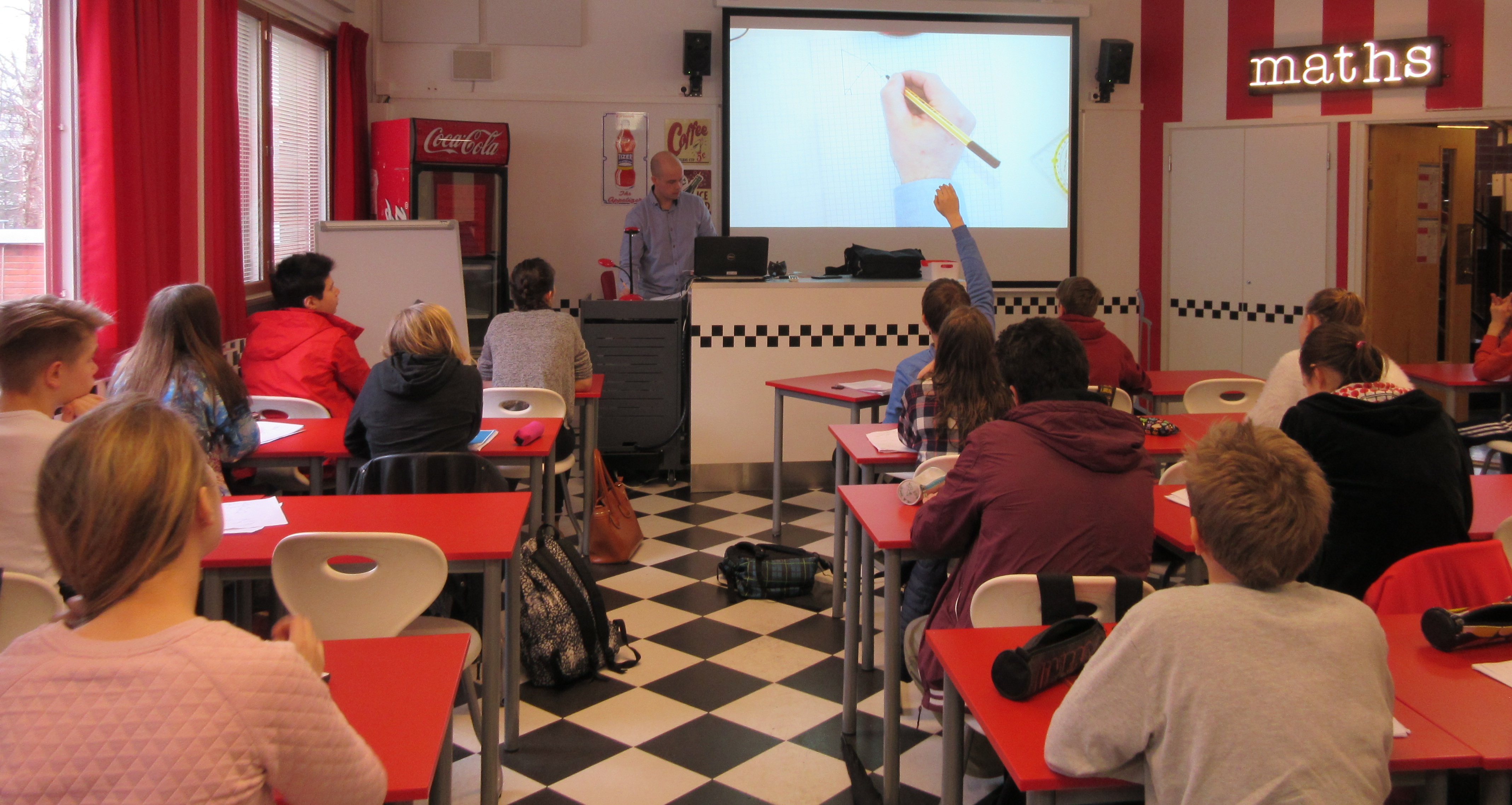
When I left my 7th grade math classroom for my Fulbright research assignment in Finland I thought I would come back from this experience with more inspiring, engaging, innovative lessons. I expected to have great new ideas on how to teach my mathematics curriculum and I would revamp my lessons so that I could include more curriculum, more math and get students to think more, talk more and do more math.
This drive to do more and More and MORE is a state of existence for most teachers in the US….it is engrained in us from day one. There is a constant pressure to push our students to the next level to have them do bigger and better things. The lessons have to be more exciting, more engaging and cover more content. This phenomena is driven by data, or parents, or administrators or simply by our work-centric society where we gauge our success as a human being by how busy we are and how burnt out we feel at the end of the day. We measure our worth with completed lists and we criminalize down time. We teach this “work till you drop” mentality to our students who either simply give up somewhere along the way or become as burnt out as we find ourselves.
When I arrived in Finland I did not find big flashy innovative thought provoking math lessons. I did not find students who were better at mathematics or knew more math content. In fact the Jr. High and High school math classrooms have been rather typical of what I have experienced in Indiana. And most of the struggles (like students not remembering their basic math facts) were the same. The instruction and classroom structure of a math classroom in Finland follows the basic formula that has been performed by math teachers for centuries: The teachers go over homework, they present a lesson (some of the kids listen and some don’t), and then they assign homework. While some lectures have been wonderful and I have gotten to observe some fantastic teachers, I would say that on the whole I have seen more engaging and interactive secondary math instruction from teachers in the United States. It is rare to see a math lesson that is measurably better than those found in my district and I have seen several that were actually far worse.
So, what is the difference? If the instruction in secondary mathematics is the same or sometimes worse than those found in the US, why are Finnish students succeeding and ours are failing? The difference is not the instruction. Good teaching is good teaching and it can be found in both Finland and in the US. (The same can be said for bad teaching.) The difference is less tangible and more fundamental. Finland truly believes “Less is More.” This national mantra is deeply engrained into the Finnish mindset and is the guiding principal to Finland’s educational philosophy.
Less IS more.
They believe it. They live by it. Their houses are not larger than what they need in which to comfortably live. They do not buy or over consume. They live simply and humbly. They don’t feel the need to have 300 types of cereal to choose from when 10 will do. The women wear less make-up. The men don’t have giant trucks (or any vehicles at all, really). Instead of buying hundreds of cheap articles of clothing the Finns buy a few expensive items of high quality that will last for decades rather than months. They truly believe and live by the mentality of less is more.
Conversely in the US we truly believe “more is more” and we constantly desire and pursue more in all areas of our lives. We are obsessed with all things new, shiny and exciting and are constantly wanting to upgrade our lives. Out with the old in with the new! This mentality of “more is more” creeps into all areas of our lives and it confuses and stifles our education system.
We can’t even stick to ONE philosophy of education long enough to see if it actually works. We are constantly trying new methods, ideas and initiatives. We keep adding more and more to our plates without removing any of the past ideas. Currently we believe “more” is the answer to all of our education problems— everything can be solved with MORE classes, longer days, MORE homework, MORE assignments, MORE pressure, MORE content, MORE meetings, MORE after school tutoring, and of course MORE testing! All this is doing is creating MORE burnt out teachers, MORE stressed out students and MORE frustration.
Finland on the other hand believes less is more. This is exemplified in several ways for both teachers and students.
Less = More
1. Less Formal Schooling = More Options
Students in Finland start formal schooling at the age of seven. Yes, seven! Finland allows their children to be children, to learn through playing and exploring rather than sitting still locked up in a classroom. But don’t they get behind? No! The kids start school when they are actually developmentally ready to learn and focus. This first year is followed by only nine years of compulsory school. Everything after ninth grade is optional and at the age of 16 the students can choose from the following three tracks:
• Upper Secondary School: This three year program prepares students for the Matriculation Test that determines their acceptance into University. Students usually pick which upper secondary school they would like to attend based on the school’s specialties and apply to get into that institution. I think of this as a mixture of High School and College. (In recent years a little less than 40% choose this option.)
•Vocational Education: This is a three year program that trains students for various careers as well as gives them the option to take the Matriculation test to then apply for University should they so choose. However, the students in this track are usually content with their skill and either enter the workforce or they go on to a Poly-technical College to get further training. (A little less than 60% choose this track.)
(But wait! Shouldn’t everyone take calculus, economics, and advanced chemistry?! Shouldn’t everyone get a University degree?! No, not everyone has to go to University! Hmmm….. interesting….. What if we provided options for those who want to become successful (and very profitable) welders or electricians? What if we didn’t force students who know that their talents reside outside of the world of formal academics to take three years of high school classes that they found boring and useless? What if we allowed them to train in and explore vocations they found fascinating and in which they were gifted? What if we made these students feel valued and like they had a place in the education realm?)
• Enter the workforce. (Less than 5% choose this path)
2. Less Time in School = More Rest
Students typically start school between 9:00 and 9:45. Actually, Helsinki is thinking of creating a law stating that schools cannot begin before 9:00 am because research has consistently proved that adolescents need quality sleep in the morning. The school day usually ends by 2:00 or 2:45. Some days they start earlier and some days they start later. Finnish students’ schedules are always different and changing; however they typically have three to four 75 minute classes a day with several breaks in between. This overall system allows both students and teachers to be well rested and ready to teach/learn.
3. Fewer Instruction Hours = More Planning Time
Teachers have shorter days as well. According to the OECD (Organization for Economic Cooperation and Development) an average Finnish teacher teaches 600 hours annually or about 4 or less lessons daily. An average U.S. teacher almost doubles that teaching time with an average of over 1,080 hours of in-class instruction annually. This equals an average of six or more lessons daily. Also, teachers and students in Finland are not expected to be at school when they do not have a class. For example, if they don’t have any afternoon classes on Thursdays, they (both teachers and students) can simply leave. Or if their first class on a Wednesday starts at 11:00, they don’t have to be at school until that time. This system allows the Finnish teacher more time to plan and think about each lesson. It allows them to create great, thought provoking lessons.
4. Fewer Teachers = More Consistency and Care
Elementary students in Finland often have the SAME teacher for up to SIX YEARS of their education. That is right! The same teacher cares for, nurtures and tends to the education of the same group of students for six years in a row. And you had better believe that during those six years with the same 15-20 students, those teachers have figured out the individual instructional needs and learning styles of each and every student. These teachers know where each of their students have been and where they are going. They track the kids’ progress and have a personal invested interest in seeing the kids succeed and reach their goals. There is no “passing the buck” onto the next teacher because they ARE the next teacher. If there is a discipline or behavior problem, the teacher had better nip it in the bud right away or else deal with it the next six years. ( Some schools in Finland only loop their elementary children for three years at a time instead of six, however the benefits are still the same. )
This system is not only helpful to a child because it gives them the consistency, care and individualized attention they need, it also helps the teachers understand the curriculum in a holistic and linear way. The teacher knows what they need to teach to get them to the next step, while also giving the teachers freedom to work at the pace of their students. Teachers don’t feel the pressure to speed up or slow down so that they are “ready” for the teacher next year. Again, they are the teacher next year and they control the curriculum! They know where the kids are and what they have learned and will plan according to the students’ needs! I really believe this is a HUGE part of Finland’s success story and it does not receive enough attention.
5. Fewer Accepted Applicants= More Confidence in Teachers
So……children have the same teacher for three to six years. What if your kid gets a “bad teacher”? Finland works very hard to make sure there are no “bad teachers.” Primary education is THE most competitive degree to get in Finland. The elementary education departments in Finland only accept 10% of all applicants and turns down thousands of students annually. A person not only has to be the best and the brightest to become a primary teacher, they also have to have passed a series of interviews and personality screenings to get in. So, it isn’t enough to be the smartest in your class, you also have to have the natural ability and drive to teach.
Finland understands that the ability to teach isn’t something that can be gained from studying. It is usually a gift and passion. Some have it, some don’t. The few universities with teaching programs in Finland make sure they only accept applicants that have that gift. On top of excellent grades, and a natural disposition to be a teacher, all teachers must get a Master’s degree and write a Master’s Thesis. This generates a lot of confidence and trust in Finland’s teachers. Parents trust the teachers to be highly qualified, trained, and gifted individuals. They do not try to interfere or usurp their authority and decisions. I asked a math teacher how many emails they typically get from parents. They shrugged and answered “About five or six”. I said, “Oh, I get about that much a day too.” They then answered…”No! I meant five or six a semester!” Again, what would it be like to live in a society based on trust and respect?
6. Fewer Classes= More Breaks
As I stated before, students only have three to four (or rarely, five) classes a day. They also have several breaks/recesses/ snack times during the day and these usually happen outside come rain or shine. These 15 to 20 minute gives them time to digest what they are learning, use their muscles, stretch their legs, get some fresh air and let out the “wiggles.” There are several neurological advantages for these breaks. Study after study supports the need for children to be physically active in order to learn. Stagnation of the body leads to stagnation of the brain and unfocused, “hyper” children.
The teachers also have these breaks. The first day I was in a school in Finland a teacher apologized for the state of the “Teacher Room.” She then commented on the fact that all teacher rooms must look like this. I laughed and politely agreed, but in my head I was thinking; “What is a teacher room?” A teacher’s room is what used to be called the teacher’s lounge in the U.S…back before they went extinct. In Finland these rooms are always full of teachers who are either working, preparing, grabbing a cup of coffee, or simply resting, socializing, and mentally preparing for their next class.
Secondary level teachers usually have 10 to 20 minute breaks in between classes and often have a few skip (prep) periods as well. These rooms are different depending on the school, but from what I can tell the basic formula is a few tables, a few couches, a coffee pot, a kitchen, a selection of free fruit and snacks, and teachers to talk and collaborate with. A few of them even have massage chairs! Ha!
So, why don’t these rooms of collaboration, support and solace exist in the U.S.? We do not have TIME! Every day we teach six to seven classes in a row with no breaks. The three to five minute passing periods we do get are often used to answer emails from parents, erase the board, get ready for the next class, make copies, answer student questions, pick up the mess left behind by the students, and (heaven forbid) go to the bathroom! If we have a spare moment we are then expected to monitor the hallway because we can’t trust students to get to class without supervision. The luxury of actually sitting down for 10 minutes and enjoying a cup of coffee with some colleagues is an absolute dream, and having a day with only three classes—that is a fantasy!
7. Less Testing = More Learning
Imagine all of the exciting things you could do with your students if there wasn’t a giant state test looming over your head every year. Imagine the freedom you could have if your pay wasn’t connected to your student’s test scores. Imagine how much more fun and engaging your lessons would be!
Although it still exists, there is overall less pressure on the teacher in Finland to get through the curriculum. The teacher is simply trusted to do a good job and therefore they have more control over their classroom and its content. The teacher is able to take more risks and try new things and create exciting, engaging curriculum that allows students to become skilled individuals ready for the real world. They have time to teach skills that allow students to develop into individuals who know how to start a project and work systematically to accomplish a goal. They have time to teach craft education where students get to learn how to do real life skills like sewing, cooking, cleaning, woodworking and more! And while they are learning these amazing skills they are also learning math and problem solving and how to follow directions!
8. Fewer Topics = More Depth
I have observed several fifth through ninth grade math classes in Finland. I have looked at the curriculum covered over these five years of education and I realized that I attempt to teach the content of five years of Finnish math education in one year. Each math topic presented in every grade level I have observed here is include in my seventh grade curriculum.
Again, the American mentality of “more is more” simply does not work. If I am to get through everything I am expected to do in one year I have to introduce a new topic/lesson every other day and I always feel “behind”. Behind what, I am not sure, but the pressure is there pushing me and my students along. In Finland, teachers take their time. They look deeper into the topic and don’t panic if they are a little behind or don’t cover every topic in the existence of mathematics in a single year.
Also, students only have math a few times a week. In fact, after Easter Break, all of my seventh graders only have math ONCE a week! My heart still panics a little when I hear this! I can’t believe that is enough math time! How will they be ready for the tests?! Oh— wait. There are no tests. There is no need to rush through. The students get to actually understand the material before they are forced on to a new topic. One teacher showed me a course book and said that it had too many topics for one five week grading period. I looked at the entire book and had to stifle a chuckle because it essentially covered what would be found in ONE chapter from my textbook. Why do we push our kids in the U.S. to learn so much so quickly? No wonder they are stressed out! No wonder they give up!
9. Less Homework = More Participation
According to the OECD, Finnish students have the least amount of homework in the world. They average under half an hour of homework a night. Finnish students typically do not have outside tutors or lessons either. This is especially shocking when you realize Finnish students are outscoring the high performing Asian nations whose students receive hours of additional/outside instruction. From what I can observe, students in Finland get the work done in class, and teachers feel that what the students are able to do in school is enough. Again, there is not pressure to have them do more than what is necessary for them to learn a skill. Often the assignments are open-ended and not really graded. Yet, the students work on it in class diligently. It is very interesting to see what happens to the students when they are given something to do. The students who were not listening to the lesson at all put away their phones and start working on the task set before them. Even if it is just a suggested assignment, they give it their full attention up to the end of class. It is almost like there is an unspoken agreement: “I won’t give you homework if you work on this while you are in my classroom.” This system has really made me think about the amount of homework I assign on a daily basis.
10. Fewer Students = More Individual Attention
This is obvious. If you have fewer students you will be able to give them the care and attention they need to learn. A Finnish teacher will have about 3 to 4 classes of 20 students a day- so they will see between 60 to 80 students a day. I see 180 students every single day. I have 30 to 35 students in a class, six classes in a row, 5 days a week.
11. Less Structure = More Trust
Trust is key to this whole system not structure. Instead of being suspicious of one another and creating tons of structure, rules, hoops and tests to see if the system is working, they simply trust the system. Society trusts the schools to hire good Teachers. The schools trust the teachers to be highly trained individuals and therefore give them freedom to create the type of classroom environment that is best for their individual students. The Parent’s trust the teachers to make decisions that will help their children learn and thrive. The Teachers trust the students to do the work and learn for the sake of learning. The Students trust the teachers to give them the tools they need to be successful. Society trusts the system and gives education the respect it deserves. It works and it isn’t complicated. Finland has it figured out.
Less IS More.

 Filling My Map
This is so interesting and insightful!
LikeLike
Love, love, love. Keep writing!!!
LikeLike
Fantastic article Kelly!
LikeLike
A very informative and interesting piece. Thanks a million for sharing.
LikeLike
Nicely put!
LikeLike
After my first year teaching business communication at the university level, I began to wonder why a class like that was a university class at all. Ninth grade in my perfect world in which most students graduate secondary school prepared for a real job that pays real money. It was great to read that Finland does that…
LikeLike
Thank you for sharing. Now I want to live there.
LikeLike
Get ready for an awful lot of snow, darkness, and people who are nice but incredibly blunt then 🙂
LikeLike
Pingback: Learning for Learning’s Sake | Filling My Map
So glad to have your article out here. All my sons could not understand why they had to spend six hours in school when it should have could have been done in two. Teaching should be a vocation.
LikeLike
I am doing a research paper on cross cultural differences in math education. Can you point me toward any scientific studies pertaining to the Finish system and or results?
LikeLike
That is wonderful! Good luck! I would start looking and comparing the PISA and TIMSS results.
PISA: (Program for International Student Assessment)
Click to access pisa-2012-results-overview.pdf
TIMSS (Trends in International Math and Science Study)
http://timssandpirls.bc.edu/
LikeLike
the PISA data is available publicly
LikeLike
Probably the more realistic reflection of Finnish Education I have ever read =). I studied Education there for one year and I completely agree with you.
LikeLike
Great piece, I am going to share it with GEEO Teacher Travel Program’s Facebook page.
LikeLike
Wow, im about to move to barbados with my 8 year old – now wishing I was going to Finland!!!!
LikeLike
You would do well to visit the Polish Education scene. There children also have the same teacher through all of Primary ed. Their day starts at various times and concludes at various times. May be some of your stated observations would be moderated by a broader general look at educzational systems beyond the USA (particularl;y in Europe)..
LikeLike
In Poland, pupils have the same teacher only during the first three years of primary education. For the remaining three years they have different teachers.
LikeLike
Thank you! Your article nails it really. I’m an Australian school principal and spend my life trying to retain the core focus of educational success while being inundated with the ‘more’ expectations. I think your description of Finnish lifestyle and priorities is pivotal to what helps acceptance of a more developmentally appropriate, child focussed school setup. In more consumer focussed societies we also have to act as free childcare for working parents caught in the spending cycle, and so need to provide long hours of attendance-while also supporting wellbeing and care issues. How are these areas supported in Finland? I would be interested in your take on that too 😊
LikeLike
Hi, kids in Finland walk/ride a bike to school independently; only 7-year-olds are offered after-school supervision. After school they have a snack at home, do homework or go to sports practise. Most parents are working full time so kids do this alone or with siblings/friends. Dinner will be at 6 when Mom returns home. It’s relatively safe on the streets of Finland – and the culture is such that independency and every day “survival skills” are valued.
LikeLike
Most schools offer “day care” services in the morning and after school for the first and second graders and special needs children. They are by different businesses but they get to use the school facilities. Parents will have to pay for it. Also churches nearby schools and city owned playgrounds that have a few workers may have those after school clubs if they are close enough the school. It is required by the law that all first graders and special needs children will have to get a place in these if the parents want it. The city must organize it. For second graders it is that if there is room enough, but usually there is.
So the schools don’t have to worry about it but the schools can focus on learning.
Some kids will not attend those child care services because either parent is home or the parents think that the child is fine being at home alone. The latter not so often, but sometimes the kid also wants to be alone at home and not in the after school day care. Most second graders do go home alone though.
LikeLike
very informative one..I am well-informed of Finland’s educational system. Much better than reading books. Thank you for sharing.
LikeLike
I cannot imagine having the same class for six years in a row, but I would like to try cycling with a class for at least two years. It does make sense that you would be able to better differentiate for each student if you had fewer students AND you were able to work with them two or more years in a row.
I wish I could do a Fulbright year in Finland! I don’t think it works for teachers who work at International Schools though…. 😦
-Amanda at http://teachingwanderlust.com/
LikeLike
WOW!
Teaching WAS my calling by God, and I adored my ninth grade students. But, after the pressures from upper administration to do more and more, and honestly, continued “to beat the dead horse,” I couldn’t go on any longer. Many afternoons I was left to defend my lessons and the poor scores given to students who did very, very little preparation, but their parents demanded an “A,” so their GPA would guarantee the child admittance into the university of their choice (usually the school their parents didn’t get into). The principal did not want parents taking their complaints to the “Big Cheese,” so I was brow beat into submission and many, many tears fell. I finally left the profession that I simply loved after fourteen years. It’s been four years since I left, and I still miss it terribly. I cried the first day of school the first year I was gone. I was a great teacher; I had such passion, and yes, I worked 60-70 hours a week, but I was glad to and felt I was helping to prepare students.
Sadly, all this “more and more” mentality is causing the U.S. to lose “more and more” of the “great teachers” every year
LikeLiked by 1 person
Karen, I understand completely. I have been teaching for a total of four years, and already feel exactly what you described, and am leaving the profession for these reasons. I still love being a teacher, but I love being a teacher who is allowed to TEACH–not test, not simply collect data, but TEACH. I don’t know that I’m done with teaching all together. I still have a deep love of it in my heart, but my body and mind simply cannot keep up with the stress it currently provides with the American education system.
LikeLike
My aunt was a teacher until she retired and my cousin is an elementary teacher, both in Finland. I can attest to the accuracy of this article. Growing up I remember being allowed to go to my aunt’s school and being part of her class for the day. I learned more in 1 day than I did in a week at my regular school. When I was visiting my cousin a few years ago, my boys got to spend part of a day in her classroom which was amazing. I know they had the same type of educational experience I had many years before too.
LikeLike
Can you imagine one teacher having 15-20 kids in their class in an American elementary school for 6 years running? The school my kids go to now would need to hire no less than 15 additional teachers, for which they have no room, and no budget. I think the key to Finland’s classroom success must have much to do with how much the residents must must pay in taxes to have such a great education system, that probably pays their teachers a lot more too. Would be curious to know how they deal with immigrants who do not speak their language, and special needs kids as well.
LikeLike
Tracy, I’m an elementary and an English teacher from Finland. We do have immigrants with limited skills in Finnish. They get additional lessons in Finnish (called S2 = Finnish as a second language) usually from a special ed teacher as long as needed. And we do try to meet the special needs of children. In my school (an elementary school with 450 students), we have four special ed teachers working side by side with classroom teachers plus six teacher aides who are assigned to those classrooms that have children with special needs. Many classroon teachers have also had additional training in special education just to be more prepared in their classrooms.
LikeLike
Of course students are not alike. Some has problems like ADHD or dyslexia. For them there are additional support before/after school by special teachers. Also it is typical that during the first (or even second) grade there is an assistant teacher helping the actual class teacher. Also there are reserved more time to answer in tests if you have dyslexia.
If a teenager is having troubles that is supported by psychologist in situations like parents are divorcing. If a teenager is having learning problems let’s say in maths, he/she can join a small groups where a special teacher helps him/her to reach the other students level. So he/she is not joining regular math classes as long as he/she manages to get over that math problem. During other classes he/she joins the rest of the class. So typically in problem situations there is established a group: student, mom/dad, class teacher, special teacher.
When an immigrant’s child participates school in Finland that is supported too. But it is amazing how quickly children learn the language when they are adopted into school. Younger the children is, the quicker he/she learns the language.
Please also pay attention to the fact that in Finnish schools there are two obligatory languages (Finnish, Swedish) and also one other obligatory language (typically English).
LikeLike
. Those who come to the country as immigrants (in their school years) first go to a preparatory class for a year. There they study the language and their other skills are assessed – like do they know how to read in their mother tongue, mathematical skills etc. After that they are sent to a regular class. Then they are offered also lessons in their mother tongue (because strong mother tongue skills are important in learning other languages). In Finnish lessons they have their own classes within school – but in some Finnish classes they are together with everyone else. If needed the special education teachers help them too.
Special education has been around very long. Even though inclusion is the trend, there still is special education classes and even a few special schools. We’ve also changed to a model close to RTI. The idea is that the child gets the support s/he needs in the regular classroom. The ways vary a bit between counties and schools, but there is usually a special needs assistant (a specific profession) in the classroom with the teacher. Co-teaching with a regular teacher and a special education teacher is a growing trend – the only obstacle being money.
A teacher to teach a special education class has to first become a primary school teacher (masters degree), then work for at least two years, apply to a special education program (1-2 years) and complete those studies. To be a special education teacher who can do testing and teach children one or two at a time (or in very small groups) or to be a co teacher, one studies a masters in special education. We do believe in educated teachers. 🙂
LikeLike
I think it’s important to consider the cultural climate too. Australian classes are often quite robust environments and a lot of time can be wasted on behaviour management rather than teaching. Are Finnish classes as multi-cultural as Australian classes and do Finnish teachers have to work hard on compliance issues? I’m very taken by the continuity of one teacher in the critical formative years in Finland.
LikeLike
The multiculturality depends on the area. The country side is less multi cultural, cities more. Like in my children’s school (grades 1-6, about 500 students) There is over 20 languages used by families. In my children’s classes there are usually around 5 original nationalities represented.
Yes, there are compliance issues. In primary school it helps that you really know your students because you’re with them every day for years. On the other hand we probably are a bit more liberal in what and how kids can behave so there might not be that much nagging on smaller things.
LikeLike
Julee Veljanovski, hi from Finland 🙂
I’ll of course let Kelly give her take on this, but I just had to let you know about two things: For first grade students (and also sometimes second grade), many elementary schools provide a day care-type of “activity club” after school. They play together, have a snack, maybe start on their home work if they want to, while they wait for the parents to pick them up from school.
Kids older than that actually go home after school. Yes, by themselves. We give our children a lot of freedom and teach them independence in that sense, we actually let them walk home or take the bus – in the rural areas there’s a school bus taking the kids home and dropping them off at a bus stop near the home. I’ve done it in the 80’s and my kids will do it when they’ll attend school. And this of course has to do with our society as a whole – there’s trust, and it’s a safe place, we do not fear that something bad will happen to the children while they make their way home.
I read an article about “free range parenting” in the USA. The parents let their kids walk to and from school by themselves, among other things. This seemed to be an outrage to many. But it’s a different society, in so many ways.
LikeLike
I have a deep admiration for the finish people and the society they have created for themselves. As far as teaching math goes, I agree that teaching less is better, but it must be taught well. In the United States we have too many elementary school teachers who do not know math themselves. That is the sources of the problem here because if you don’t know it, you can’t teach it. Great article!
LikeLike
I apologize for the spelling. I should be Finnish people.
LikeLike
Pingback: Fulbright Conference in Germany | Brad + Katy
This is so nteresting! I’m a teacher in France, not in the US, and our system is pretty much like in the US, with classes of 30-35, nobreaks in between classes except one 10 minute break in the morning and afternoon, and the kids have 6 to 8 classes a day. But we do have a staff room!! 😉 This whole system is very thought provokative. I’m glad to hear some countries get it right! I’d love to have a more sensible system too. It is at the same time uplifting and depressing: not sure I’ll see the day when it all changes for the better here in France. The society (government / parents / students) are certainly not ready for that. Yet. Thanks for sharing!
LikeLike
Reblogged this on Through The Looking Glass and commented:
A very interesting article about schools in Finland. I think giving breaks and allowing students and teachers time to relax is a very good idea!
LikeLike
Michael. Yes we do have in Finland special schools for ADHD etc wild kids where teacher has extra person to help with beahviour. How ever we have in most schools intergraded classes inside regular school where teacher has also extra person to help with behaviour and teaching. Those classes has up to 10 students so teacher has even more time to help each student by their needs.
LikeLike
Timo, we don’t have any special schools for children with ADHD in Finland or for those with other behavioural issues. We do have a few special schools for deaf, for bilnd and for mentally retarded people. There are a very few for those with severe learning disabilities as well (which no longer should not exists really, but some counties have kept them). We also have a few hospital schools (for a very small number of people) who have very serious issues with behavior and other things.
LikeLike
Great stuff. This is brilliant, and I’m a living example of it. I struggled in all the way through school until college where I did a good bit better, and then in grad school my grades have skyrocketed.
I’m sure maturity has a lot to do with it, but the reduced course load and simpler structure is way more conducive to learning. American education is incredibly cluttered in that regard, nothing is simple.
I also really like that Finland is completely fine with embracing vocational studies. One thing I’ve learned from working in student affairs is that college is definitely not for everyone, but everyone thinks it has to be.
LikeLike
Thank you for this article, it was very interesting to read. However, being from Finland and having gone through the Finnish school system (primary/elementary school 9 years, upper secondary school 3 years, university 5-6 years and now working as a university teacher), I cannot fully agree with everything you write. I don’t know anybody who has had the same teacher for the first six years! Maybe that exists somewhere in Finland (since you mention it – different schools have different systems), but for example when I went to primary school (about 30 years ago) the typical system was one teacher for grade 1-2, another one for grade 3-4 and yet another one for grade 5-6. After that you changed to another school for grades 7-9 where you had different teachers for different subjects. Today, in my son’s school, they have one teacher for grades 1-3 and another one for grades 4-6. After that he will go to another school. I believe this is more typical for primary schooling in Finland. Also, 30 years ago, we had around 25-35 pupils in the same class. Today I think they try to keep it around 20.
Older children (e.g. upper secondary school) might have 7 hours a day in school.
Somebody asked about children with special needs. I think that there might still, in some schools, be separate groups for children with special needs but for example in the school my son attends, children with special needs (like Down’s syndrome) are in the same class room as the other children. These children have their own assistants, so in these classes where children with special needs are integrated there might be a little less than 20 pupils and e.g. five adults. Then there are of course teachers educated for children with special needs and school welfare officers/counselors and school psychologists available to help children with different kinds of problems. (However, not every school has their own psychologist/counselor.)
A class room in Finland is typically not at all very multi-cultural (except for maybe in some of the big cities) and personally I believe that that is a big difference compared to many countries. Bilingualism might, however, be some kind of challenge for teachers in some parts of Finland.
Schools in Finland are not used as free child care, but in grades 1-2 the municipalities should organize care for children after school. (The typical family situation is that both parents work so you will not have a parent at home taking care of the child when he/she finishes school for the day.) So in grades 1-2 many children attend something called “afternoon care” where they will get a meal and get to play (and sometimes do their home work). They will stay there until picked up by a parent, quite similar to the day care system for smaller children. The afternoon care is not free, but since we pay a lot of taxes in Finland, the fees are not too high. Generally education is free (payed by taxes) so also the universities are free. =)
LikeLike
Yes, it’s different in different areas of Finland. No point bringing up what it was like 30 years ago because school has changed much. In my kids schools they tend to have the same teacher for 6 years, unless the teacher takes a maternity leave or moves or retires. I know many schools who work this way.
But even 2 or 3 years with the same teacher is better than 1 🙂
LikeLike
Reblogged this on My Beautiful Brown Life and commented:
Even though I homeschool, I am a big proponent for educating children in effective ways across the board. I think Finland has got it down. It’s time for the US to step it up in a lot of ways,
LikeLike
As a retired middle school teacher with 37 years of experience I am not surprised by these findings. I have always felt we start formal education way too early, and keep changing the curriculum every 5 years or so. Maybe the Beach Boys said it best with the lines of one of their songs ” when I think of all the crap I learned in high school”. As David Thoreau said “simplify, simplify”!
LikeLike
That’s a line from Kodachrome by Paul Simon. 🙂
LikeLike
We chose to teach our kids at home for all of the reasons mentioned in this article. They actually graduated early and went on to the Navy, community college, church mission work, and their chosen fields.
LikeLike
Great article! Thank you for sharing. After several years of trying to motivate a distracted, overwhelmed, disorganized child, we finally decided homeschool is the way to go. The thing that was the most stressfull in our household is now the least; no homework, less structure, self paced, interest driven, learning freedom!
LikeLike
Reblogged this on Confessions of an English Major.
LikeLike
Kelly, I must confess that I stopped reading after point #6. I hope to come back and read the rest, but I simply cannot right now. I can’t take it. It is simply too good. I am reminded of C.S. Lewis’s line about the “ignorant child who wants to go on making mud pies in a slum because he cannot imagine what is meant by the offer of a holiday at the sea.” I do not want to make mud pies, but I cannot handle the searing, blazing light of the true, the good, and the beautiful that you describe. I am like Plato’s man in the cave who, upon being led from the depths of darkness, finds his eyes blinded by the light of the sun.
I am the 2014 Indiana Teacher of the Year. I have been blessed with opportunities to see schools around our state and to work with amazing educators across the nation and beyond. The contrast between what you describe and the lives of teachers here is so stark and so vast that, for the moment at least, I cannot get across it. Thank you for sharing this piece. I hope to have the courage to embrace the possibility of such learning environments here.
LikeLike
Thank you Steve! I also teach in Hamilton County. Perhaps we can meet up and discuss Indiana education when I return to my teaching position this fall.
LikeLike
I would love to talk with you, Kelly! Let me know when you are “back home again in Indiana.”
LikeLike
I grew up in Germany and the system is very similar. You have the same teacher until 4th grade and then again the same teacher from 5th to 10th. The responsibility to get to where you need to be is left up to the kid. No one ever supervised us. I walked alone or with friends for 3 miles to school every day rain or shine and was responsible to cross the street or ride a public bus alone at the age of 6 without a cell phone on which my mom could call me every 5 minutes. Living in the US now and having kids of my own I can’t allow my 8 year old to walk to school alone with a cell in hand. I do apply some of my experiences to her. I never help her with homework and rarely ask if she completed it. I feel like it is her responsibility to keep track of and answer to her teacher if it’s not completed. It has worked for me because my daughter is an A student and in the gifted program. It’s all her own achievements that she can be proud of and not her mother breathing down her neck.
LikeLike
I love the ideas presented here, but I have to say that they don’t exist in a vacuum. In order for most of these ideas to be successful, a similar educational structure would have to exist in the United States. Finland currently enjoys a system in which all students have equal access to an education with highly trained teachers. Schools are fully funded, teachers are adequately paid, and students can attend preschool programs, and college for free. In addition, classroom size is limited to roughly 20 students. This structure is only accomplished by proper funding. The people of Finland do this by paying a progressive state tax and a 16-22% municipal flat tax. They pay for a proper structure because they understand the importance of an educated populace. The idea of less is more is born out of the actions of a society who choose to invest in their children.
LikeLike
Thank you so much for sharing this. I was about to go to bed when I saw your post and because I had a long and tiring day, I thought I couldn’t finish it anymore. But I did. Everything you’ve written is an eye opener and if only I could, I’d move to Finland in a snap!
Somehow, I feel glad that there is at least one country that has this amazing education system that we can copy or adopt. However, I also feel hopeless that it would take YEARS (who knows how many) before we can achieve what Finland has achieved. In fact, it might never happen for us in the Philippines. People are resistant to change and it would be extremely difficult to alter the educational system that people have been accustomed to. Sigh.
LikeLike
Pingback: 11 Ways Finland’s Education System Shows Us that “Less is More”. | The GI Secondary School Teachers' Blog
In American schools students are also ranked in class by their grades.
Awards are given out like candy.
The push on students to be academically perfect isn’t reasonable or realistic.
There are stories of good, hardworking students committing suicide. The pressure to succeed is too much.
I’m curious to know the statistics that Finnish students commit suicide.
LikeLike
15-19 year olds’ suicides were for girls about 7/100 000 and for girls about 18/ 100 000 a few years back. There’s a little variation between years, but not much.
LikeLike
Thanks for the feedback. In retrospect America and Finland both have suicides based on their per capita.
LikeLike
I would make the comparison with great caution, seeing that many other factors can play in. Notably, Finland has reputation for high suicide rates, often attributed to long, dark winters. The same applies e.g. to the northern parts of Sweden.
LikeLike
I have heard of the doom and gloom of winter. It seems that education is not a factor in suicides. Unfortunate, every country has there highs and lows.
LikeLike
The suicide rate in Finland has been exaggerated for some reason, it seems to be currently between Belgium and Austria. Also there is something called the suicide paradox, the rate is often higher in places with higher standards of living. The explanation usually is that the people who are less succesful in those societies feel worse when almost everyone around them is enjoying their lives. If everyone else is also unemployed or poor, for example, losing one’s job doesn’t feel like a failure.
LikeLike
This is a system that should be adopted in other countries as well. I lived in Germany for 5 years and the system was very similar. Students were taught trades so that when they graduated, they were already or nearly qualified trades people. Of course, some go to college or university afterwards. But why have a student learn algebra or chemistry when their real interest and skill lies in some type of trade.
LikeLike
Yeah, Finland! This very mindset was the way of my Finnish grandparents in all of their living. A number of years ago, I met an elderly lady, who told me that when she was a child in Norway, all the students were required to learn to knit or crochet. The reason given was that it instilled attention to detail, created a path for structured learning, and gave a sense of accomplishment that encouraged learning in various fields.
I sometimes wonder if they still use this structure for developing a learning environment. Have a great day.
Margaret
LikeLike
Yes! They do. My next blog will be about craft education.
LikeLike
Yes, at least here in Finland kids still have to learn to knit and crochet and to use the sewing machine, boys and girls alike. The same way they all have to learn to use the saw and drill and hammer too. In the fist two grades it is integrated in everything they do, grades 2-6 it’s two lessons (1½ hours in one go, often one semester one of them and the other semester the other, class split into two.) a week and I think they still have that on the 7th grade too, but then they can choose to take needle craft or woodwork or neither.
LikeLike
Thank you for sharing your experiences. As an educator living in 3 former Communist countries of Eastern Europe for 15 years, I can say that the education format/structure is very similar to Finland’s. However, I agree with earlier comments that suggest that the value of educators is one of the greatest factors in the success of the Finnish system. I have met some talented high schoolers in these countries who would make excellent teachers, but they either won’t or are not allowed by their parents to pursue pedagogy because the pay is too little to live off of. When you described the competitive nature and high standard of accepting and training educators in Finland, I believe you shared the key to their successful system.
As one who grew up in the American system and has relatives still teaching in the U.S., I would also put forth the question mentioned in an earlier post about the diversity of people found in Finland. I believe they are rather homogeneous, which is a significant factor. Where there is a common view of the world, values, and suppositions about life, it reduces a lot of the issues/tensions that Americans classrooms must deal with, as educators can then focus on teaching and not addressing social issues to the extent that Americans schools do.
LikeLike
Thanks for writing this article. It resonates on so many levels!
LikeLike
Pingback: 11 Ways Finland’s Education System Shows Us that “Less is More”. | anotherblognobodyreads
The problem is that there are multiple elephants in the room here.
The first one is size: Finland has a population of 5.4 million people, while the United States has a population of more than 300 million. Effective centralized oversight of Finnish schools doesn’t require nearly as much bureaucracy as centralized oversight of American public schools would–and there would be, proportionally, many more bureaucrats needed for the USA. Also, Finland is the size of New Mexico.
The second one is cultural homogeneity. More than 90% of Finns have Finnish as their first language, and most of the rest have Swedish. The United States, on the other hand, has a bit more than 80% of its population with English as a first language, with most of the rest speak Spanish. While the differences between the English and Spanish are less than between Finnish and Swedish, culturally speaking, Sweden and Finland (due to long association) have much closer cultures than the United States and its southern neighbors.
The third one is that Finns aren’t having kids. Sure, less might be more, but the fertility rate is standing at 1.7 children per mother, and the last time Finland was over replacement rate was back in the late 1960s. Also, there aren’t a lot of immigrants–which is where most of America’s population increase over the past few years has been, as we’re sitting on 1.9 children per mother, which has been where we’ve been since the early ’70s, although we hovered around 2 between 1988 and 2010.
In other words, it’s comparing an orange to a bushel of oranges.
LikeLike
True, only about 6% of the population has other than Finnish or Swedish as their mother tongue. (More than Swedish nowadays actually).
But I have understood by many US friends that States have pretty much independence in their schooling systems. One cannot compare Finland to the whole of US, but many tend to think that individual States could benefit much.
I think the biggest obstacle in anything is the thought of “It can’t be done here because….”
LikeLike
Wow, I taight math through a Fulbright grant last year in South Africa and I witnessed the complete opposite:
*6:30am-4:00 mandatory school day
*no breaks in between classes
*no physical activity
*more time spent preparing for or taking exams than learning
*teachers spent most of their prep time marking exams
*incredibly wide span of material covered on national testing
*excessively large class sizes/no individual attention
*students facing extreme challenges in passing math
I know Finland has much more money going into each student’s schooling than the townships in SA, but there has to be a way to start implementing the strategies that are succeeding there.
I’d be curious to read about the negative aspects of the system Finland you’ve experienced so far.
Thanks so much for sharing this,
Mike
LikeLike
Some negative aspects: Since teachers are given the freedom to do things as they like to do them, when you do have a bad teacher, it is hard to get rid of them. In order to be fired they really need to do something bad (if they have a permanent position). Just being a lousy teacher isn’t enough.
There is a culture of doing alone, but it is changing, teachers collaborating more.
As a a teacher you end up doing more than you’re paid for, but I think that’s everywhere.
Finland is often criticized that the students don’t enjoy being in school. It may be a bit boring compared to some things I’ve seen. The main point isn’t to make it fun, it is to learn. They are not exclusive, but the focus is more in learning. But I’m not sure about those surveys. Personally I’ve never met a student who hates school. I know they do exist. Our culture is such that the mentality is that work and school is not supposed to be fun. If you’re asked if you enjoy school (after the first two grades) you’re supposed to say you don’t. If you do, it’s almost as bragging, saying that you’re so good that you enjoy school. Peers quickly tell kids that enjoying or liking school is not ok.
We as a nation are not very talkative. We should teach more about how to discuss things. We should encourage more even debates. Also kids should get more education on feelings and things like that. Of course it would be the parent’s responsibility, but as it is, schools should take more responsibility. Towards which we are moving to.
LikeLike
A very interesting read. I have long claimed that the views on schooling that dominate in e.g. the U.S. or my native Sweden are largely detrimental. I cringe everytime I hear yet another naive politician demand longer school hours, more mandatory education, whatnot. For example:
o The best way to make students learn is to make them want to learn. A long school day followed by a few hours of homework achieves the exact opposite: School becomes a tedious chore.
o There are diminishing returns to everything, including schooling, and in many cases the students who try to keep up with the expectations actually have negative returns. (Remembering less and understanding far less than if they had less to do.)
o Not everyone is suited to or interested in higher education. Pressing these through college leads to a lack of resources for the “traditional” college students and forces the lowering of success criteria in order to keep the graduation rate up. In addition the value of a diploma is diminished and the proof of intelligence and inherent ability that a diploma once brought disappears.
o More schooling requires more teacher-hours. More teacher-hours requires either more teachers, implying the need to make less qualified candidates teachers, or more hours per teacher, which reduces the quality of the education per hour.
LikeLike
Reblogged this on Mind Over Mutter.
LikeLike
very interesting. Not sure the Indiana vs finland is comparing like with like but the points are well made. So do you think that Finland’s educational philosophy will eventually lead through to global economic dominance? (well…of a limited kind 🙂 )
LikeLike
I think that question is a good one and shows the difference in thinking. We don’t even want that. It is enough to survive well enough to look after our own.
LikeLike
Pingback: School talk | EXEciting English
Great post – very interesting!
LikeLike